Shop this guide
MLP TCG DISCORD!!! Booster Box
The Series 2 expansion of the playable MLP TCG: 20 English foil packs, in stock and dispatched from NSW.
View the DISCORD!!! boxQuick Answer
The My Little Pony TCG is a two-player card game from KAYOU and Hasbro. Each player brings a 70-card deck: a 50-card Main Deck, a 15-card Scene Deck, four Story cards and one Main Character. You tap Scenes to pay Force of Harmony, play Characters into three lanes, and in the Contact Phase the Characters facing each other compare Inspiration. A Character with nobody opposite lets you promote your Main Character up your Story or remove one of your rival's Plans. Reach Stage IV of your Story and you win, and you also win if your rival has to draw from an empty Main Deck. The easiest way in is one Friendships Begin starter deck per player.
What you need
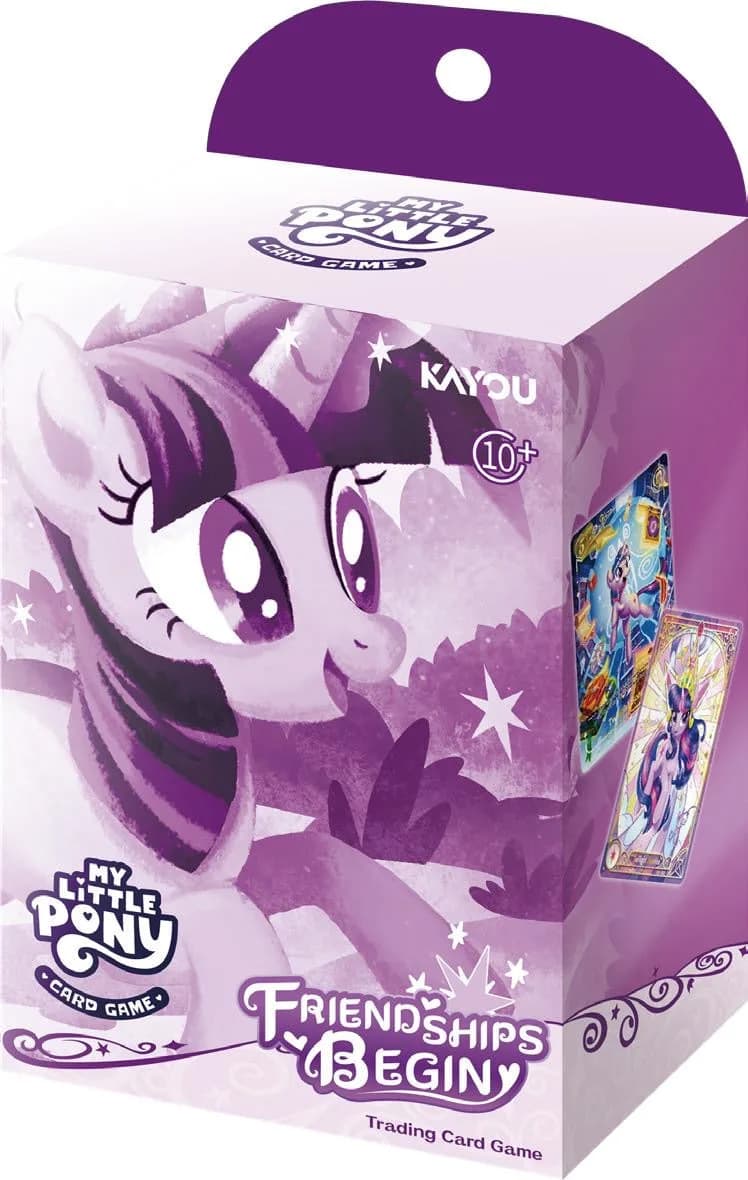
If you have just opened a starter deck and the playmat looks like a lot, start here. Everything for a first game comes in a Friendships Begin starter deck. Each one is a complete, ready-built 70-card deck for one player, sealed with three booster packs, a character-themed paper playmat and the rules. There are six decks, one for each of the Mane Six, and the rules are written for two players, so a first game needs two decks.
Booster packs and booster boxes are a different thing. Fantasy Wonderland, DISCORD!!! and Nightmare Night boosters contain no rules and no ready-made deck. They add cards to a deck you already own, so if nobody in the house plays yet, buy starters first and boosters second.
Beyond the decks you need a table and about 20 to 30 minutes a game. The rules let you use any object as a token if both players agree, so a button or a bead will do the job.
One thing to check before you start: KAYOU's Friendship Eternal cards are collectibles with no rules, and they do not play in this game. Our series explainer sorts out which of KAYOU's My Little Pony cards are which.
The deck
Every player's deck has four parts, and a starter deck arrives built to this exact shape.
| Part | Cards | What it does |
|---|---|---|
| Main Deck | 50 | Characters, Events and Items: the cards you draw and play |
| Scene Deck | 15 | Scenes, which pay for your cards and boost Inspiration |
| Story | 4 | One Story card for each Stage, I to IV, all sharing one main title |
| Main Character | 1 | The card that climbs your Story |
Characters go into your lanes and carry an Inspiration number. Events resolve as you play them and then go to your Retirement Area, which is the game's discard pile. Items attach to a Character in the Adventure Area, and a Character normally holds one Item at a time, so a new Item replaces the old one.
When you start adding booster cards to a starter, two limits apply. You can run no more than four copies of any card ID, and a Shining (※) parallel counts as the same card as its base version. Everyday Scenes are the exception: you can put as many of those in your Scene Deck as you like. The rarity printed on a card has no effect on play at all.
Setup
- Shuffle your Main Deck and Scene Deck, then let your rival shuffle or cut them. Both go face down in their places.
- Put your Main Character on the left of your Story Area and lay your four Story cards out to its right, Stage I to Stage IV.
- Decide who goes first any way you both agree on. Rock, paper, scissors works.
- Draw five cards. You may mulligan once: put your whole hand on the bottom of your Main Deck in any order and draw five new cards. The first player decides first.
- Take the top four cards of your Main Deck and put one face down on each of your Story cards, in Stage order. These are your Plans, and each one stops your rival promoting to that Stage.
- The first player puts the top card of their Scene Deck into their Scene Area face down. The second player puts theirs in face up.
That last step matters more than it looks. A face-down Scene can still pay for cards but cannot give an Inspiration Boost, so the player going second starts the game with one more face-up Scene than the player going first.
A turn: Starting, Main, Contact and End
Players alternate turns, and every turn runs the same four phases in order.
Starting Phase. Untap your tapped Characters and Scenes. Draw one card, except on the very first turn of the game, when the first player skips the draw. Add a Scene: the top card of your Scene Deck goes into your Scene Area face up and untapped, unless your Scene Deck is empty. Then resolve any start-of-turn effects in the Upkeep Step.
Main Phase. Spend Force of Harmony to play cards from your hand. You can also use activated abilities on your Characters. A Character goes into an empty slot of your choice. An Event resolves and then goes to your Retirement Area. An Item attaches to a Character in the Adventure Area.
Contact Phase. This is skipped on the first two turns of the game, so each player gets a turn to set up before anything clashes. After that, the lanes are checked one at a time, and what happens in each one depends on who has a Character there. The sections on lanes and winning below cover it.
End Phase. Effects that last until the end of the turn finish. If you are holding 11 or more cards, discard down to 10.
Force of Harmony and Inspiration
These are the two numbers the whole game runs on.
Force of Harmony is the cost. It is printed in the top-left corner of Characters, Events and Items. To pay it, tap exactly that many Scenes, no more and no fewer. You start with one Scene and add one every turn, so you have two to spend on your first turn and one more each turn after that. Face-down Scenes still tap for Force of Harmony.
Inspiration is strength in a contact. It is printed near the bottom of a Character, and when two Characters meet in a lane, the higher final Inspiration wins. Card effects push it up or down, but a Character's Inspiration never drops below zero.
Inspiration Boosts come from face-up Scenes. During a contact, the player whose turn it is may use the boost on any face-up Scene, one Scene at a time, turning each one face down after use. Then the rival gets the same chance. Some boosts only work for a named Character. A Scene that has been turned face down cannot boost, but it still pays Force of Harmony, so every face-up Scene is a small decision: use it in this fight, or keep it for a bigger one.
The three lanes
Your Adventure Area has three slots, and your rival's three sit directly opposite. Each facing pair is a lane. When a Character comes into play you choose its slot, and after that it stays put unless a card effect moves it. With all three of your slots full, you cannot play another Character from your hand.
In your Contact Phase the lanes are checked in a fixed order: the first player's left lane, the middle lane, then the first player's right lane. In each one:
- You both have a Character: contact. You use any Inspiration Boosts you want, then your rival does, and the final Inspiration totals are compared. The loser retires to the Retirement Area and the winner stays where it is. On a tie, both retire.
- Only you have a Character: take an action. Choose one: Promote the Story or Intervene the Plan. Both are explained in the next section.
- You have no Character there: nothing happens in that lane this turn.
When a Character retires, any Item attached to it goes to the Retirement Area too, and its Farewell ability, if it has one, triggers.
Two things follow from the lane check. An empty slot on your rival's side is an opening, because an unopposed Character is the only way to take an action, and three open lanes can mean three actions in a single Contact Phase. And putting a Character opposite one of your rival's Characters turns that lane into a contact on their turn instead of a free action.
How you win
There are two ways to win, and the first is the one the game is built around.
Promote your Main Character to Stage IV. Promote the Story moves your Main Character onto your next Story card. It is blocked if your rival has a Plan on their Story card of the same Stage: to move up to Stage II, for example, your rival's Stage II Story must have no Plan on it. When you arrive on Stages I to III, that Story card's ability resolves. Arrive on Stage IV and you win.
Intervene the Plan to clear the way. This removes the Plan on your rival's lowest-Stage Story card. The removed Plan is turned face up. If it has a Pre-plan ability, that ability works for your rival and the card goes to their Retirement Area. If it does not, your rival adds it to their hand. So clearing a Plan usually hands your rival something back.
Because each player starts with a Plan on all four Stages, a straight run to victory takes four Interventions and four Promotions, unless card effects remove Plans or add new ones along the way.
Deck your rival out. If your rival has to draw from an empty Main Deck, you win. Each Main Deck still holds 41 cards once the opening hand and the four Plans are dealt, so at one draw a turn this is the slower route unless card effects make players draw extra.
If both players meet a win condition at the same time, the game is a draw.
Ability icons
Abilities on Characters are marked with icons that tell you when they happen.
- Appear triggers when the Character is played from your hand, or moved into your Adventure Area by another ability.
- Farewell triggers when the Character leaves your Adventure Area, whether it lost a contact or a card effect removed it.
- Pre-plan triggers when the card is removed from your Story Area as a Plan. Some Events carry a Pre-plan effect too, and it only works when the Event is removed as a Plan, never when you play it as an Event.
Effect text on Characters comes in three kinds:
- Triggered effects use "when" or "each time when" and happen as soon as the condition is met. Unless the card says otherwise, you must use them.
- Continuous effects apply for as long as the Character is in your Adventure Area.
- Activated effects have a cost and an effect, and you can use them during your Main Phase.
When a card and the rules disagree, the card wins, and KAYOU's official card Q&A outranks both.
Tokens: Treats and Nightmare Night
Tokens are markers placed on cards. They never go into a deck, and their card numbers usually start with TK-.
Treat tokens arrive with Nightmare Night, the game's third booster set. A Treat goes on a Character in the Adventure Area and does nothing by itself. What matters is that some card effects check whether a Character has a Treat, or count Treats. A Character can hold one Treat at most, so an effect that would give it a second one does nothing. When the Character leaves the Adventure Area the Treat is removed, and removing it that way triggers nothing.
Nightmare Night releases in Australia on 2 October 2026, and the product page shows the dispatch date for the Nightmare Night booster box and the single booster pack. Our Nightmare Night guide covers the card list and the six new stories.
Present tokens are also defined in the rules: six Mane Six Presents that can be unwrapped at the start of a turn for a one-off effect, such as adding a card to your hand or a small Inspiration change. They are not in the Nightmare Night card list we have seen, and we have not confirmed which product introduces them.
Your first purchase
Buy one starter deck per player, then add boosters once you know the game.
Start with Friendships Begin. Pick each player's pony: Twilight Sparkle, Rainbow Dash, Pinkie Pie, Fluttershy, Rarity or Applejack. We sell every character as its own deck, such as the Twilight Sparkle starter deck, so nobody ends up with a pony they did not want. Each deck's four Story cards follow that character's own arc, from Twilight's search for the Elements of Harmony to Applejack bringing in the apple harvest. The NA and SEA prints of the decks are the same English game, so the print does not change how they play. For a household that wants every pony, the Friendships Begin starter set puts all six decks in one box.
Add DISCORD!!! next. The DISCORD!!! NA booster box is Series 2: 20 packs of five cards, from the set that made Discord himself deck-buildable. It widens what you can build around your starters. If you are opening for collecting as well as play, our DISCORD!!! most valuable cards guide covers the chase cards.
Nightmare Night after that. Series 3 releases in Australia on 2 October 2026, brings Treat tokens, and plays with everything above. The product page shows the dispatch date.
Every set shares one rulebook, so Fantasy Wonderland, DISCORD!!! and Nightmare Night cards all mix into the same Main Deck. The full range is on our My Little Pony TCG page.
Where the official rules live
KAYOU publishes the Comprehensive Rules as a PDF, linked from its official website, kayouofficial.com. The current version is 1.3.0, dated 26 May 2026, and it is the document to check when a question comes up at the table. It already covers Treat tokens, in section 207.2.1, and uses Nightmare Night cards in its worked examples, so there is no separate rules update to learn for Series 3.
For a first game you do not need the PDF, because the rules that come with every starter deck are enough to play. KAYOU's official page also links to its US Discord server and social channels.
This guide follows version 1.3.0. If KAYOU publishes a newer version, the newer document wins.
Frequently Asked Questions
How many cards do you need to play the My Little Pony TCG?
Seventy per player: a 50-card Main Deck, a 15-card Scene Deck, four Story cards and one Main Character card. A Friendships Begin starter deck is exactly that, ready to play.
Can two people share one starter deck?
No. A starter deck is one player's complete deck, so two players need two decks. The six characters are sold as separate decks, so each player can pick their own pony.
How do you win the My Little Pony TCG?
Promote your Main Character to the Stage IV Story card, or make your rival draw from an empty Main Deck. To promote, you need a Character in a lane your rival has left empty, and no rival Plan on the Stage you are moving to.
How long does a game of the My Little Pony TCG take?
About 20 to 30 minutes. The Contact Phase is skipped on the first two turns of the game, so the opening turns are quick.
Do booster packs come with rules?
No. Boosters add cards to a deck you already have. The rules come with the Friendships Begin starter decks and in KAYOU's Comprehensive Rules, version 1.3.0.
Can you mix Fantasy Wonderland, DISCORD!!! and Nightmare Night cards in one deck?
Yes. They are sets of the same game with one rulebook. Keep to four copies of any card ID, and remember that a Shining (※) version counts as the same card as its base version.
Keep Exploring
Continue into the most relevant buying pages and cornerstone guides from this topic.
Set guide
MLP TCG Nightmare Night Guide
Series 3 explained: the 190-card list by rarity, six new Hasbro stories, Treat tokens and the Australian release.
Read the Nightmare Night guideIn stock
MLP TCG DISCORD!!! Booster Box
The Series 2 expansion of the playable MLP TCG: 20 English foil packs, in stock and dispatched from NSW.
View the DISCORD!!! boxStarter decks
Friendships Begin Starter Decks Compared
All six character decks side by side: what every deck contains, how they differ and which one to buy first.
Compare the starter decksChase cards
DISCORD!!!'s Most Valuable Cards
The MLP TCG Series 2 chase ladder: the one-per-case Shining Ruby Rares, pull rates, and eBay sold prices in AUD.
See the Series 2 chase cardsWritten By
Cottier TCG Editorial Team
Bringing you accurate KAYOU collecting news and buying guides for Australian collectors. Based in the Central Coast, NSW Australia.
Collectors Club
Enjoyed this guide? Get the next drop first.
Join the Collector's Club for restock alerts, new collector guides, and early access to KAYOU boxes before they sell out.
New members get 10% off your first order
Keep Reading
Other stories you might enjoy from our experts.
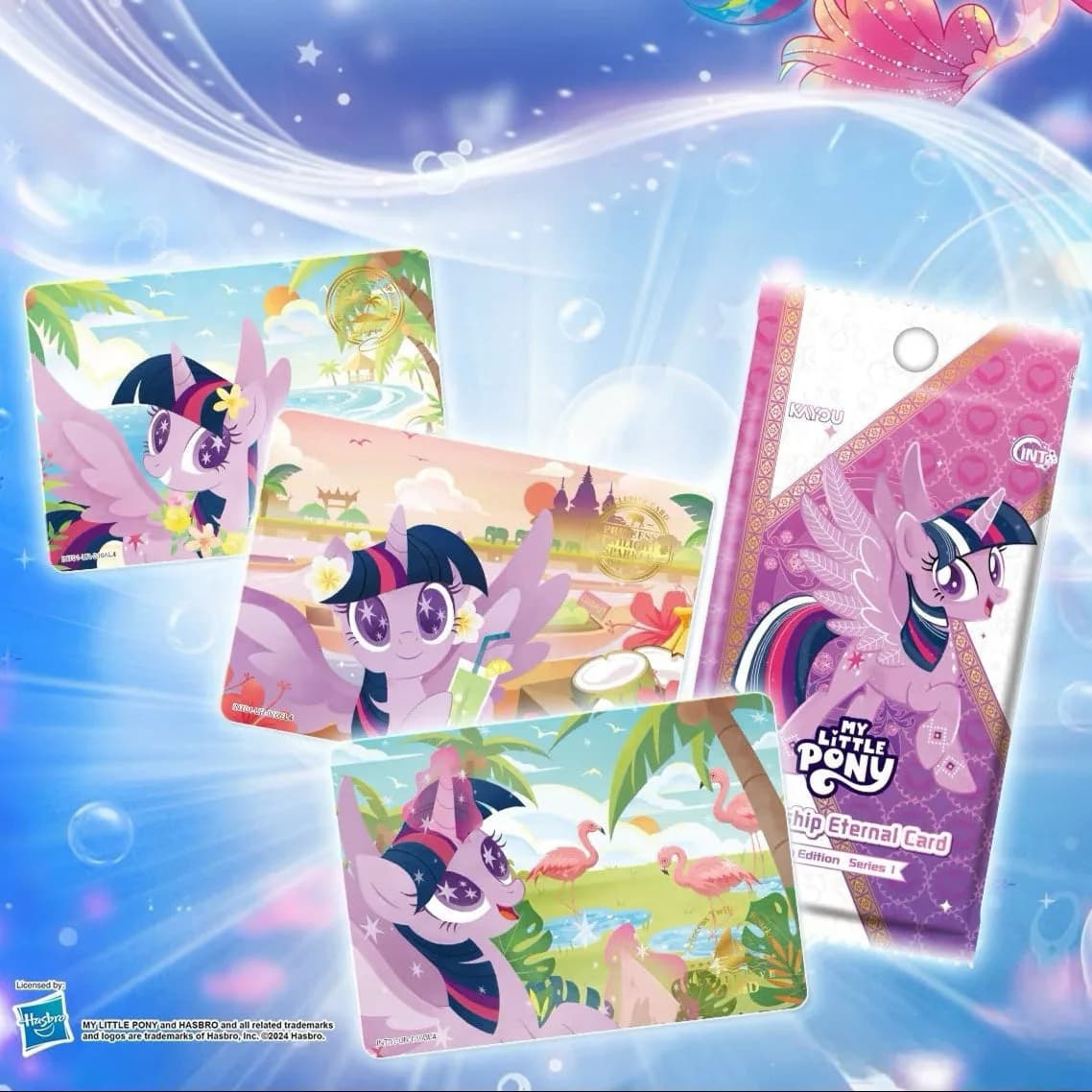
KAYOU My Little Pony Moon Edition explained: every Moon series in the SEA and NA editions, the rarity tiers and pull rates KAYOU publishes, where to find the card lists, and Star Edition.
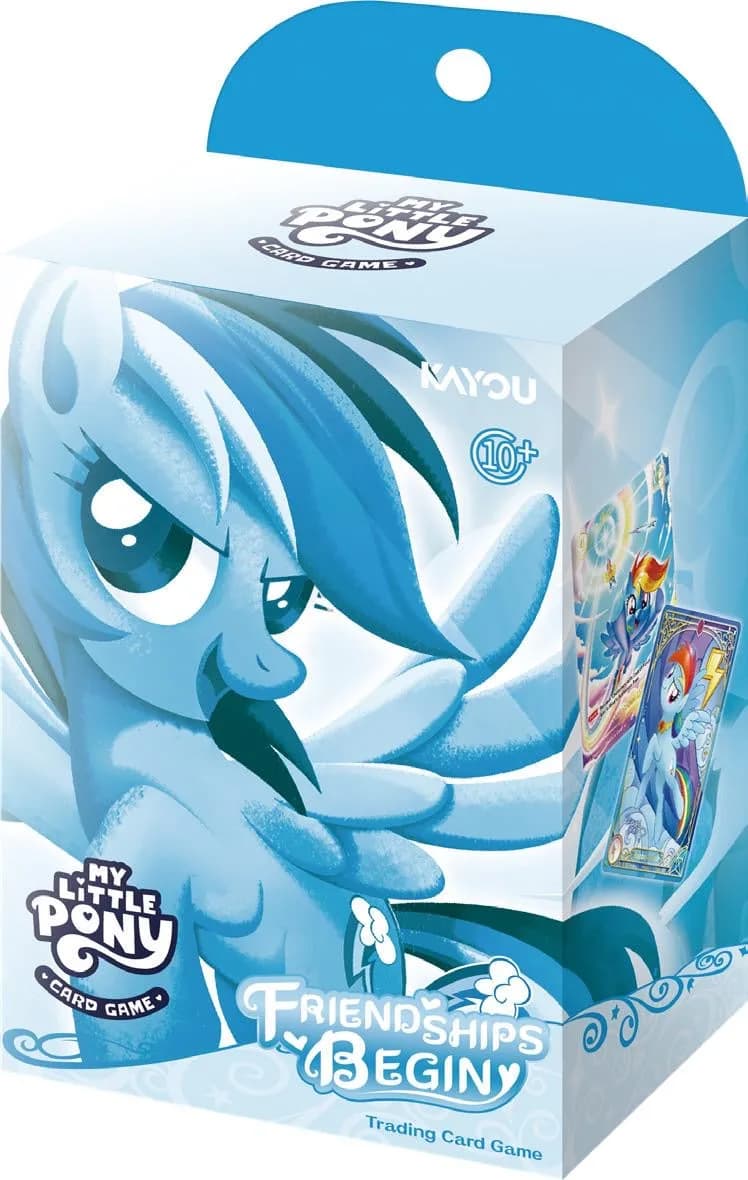
Friendships Begin Starter Decks Compared: Which My Little Pony TCG Deck to Buy First
The six My Little Pony TCG Friendships Begin starter decks side by side: what every deck contains, each pony's story, support cast and signature cards, and how to pick your first deck.
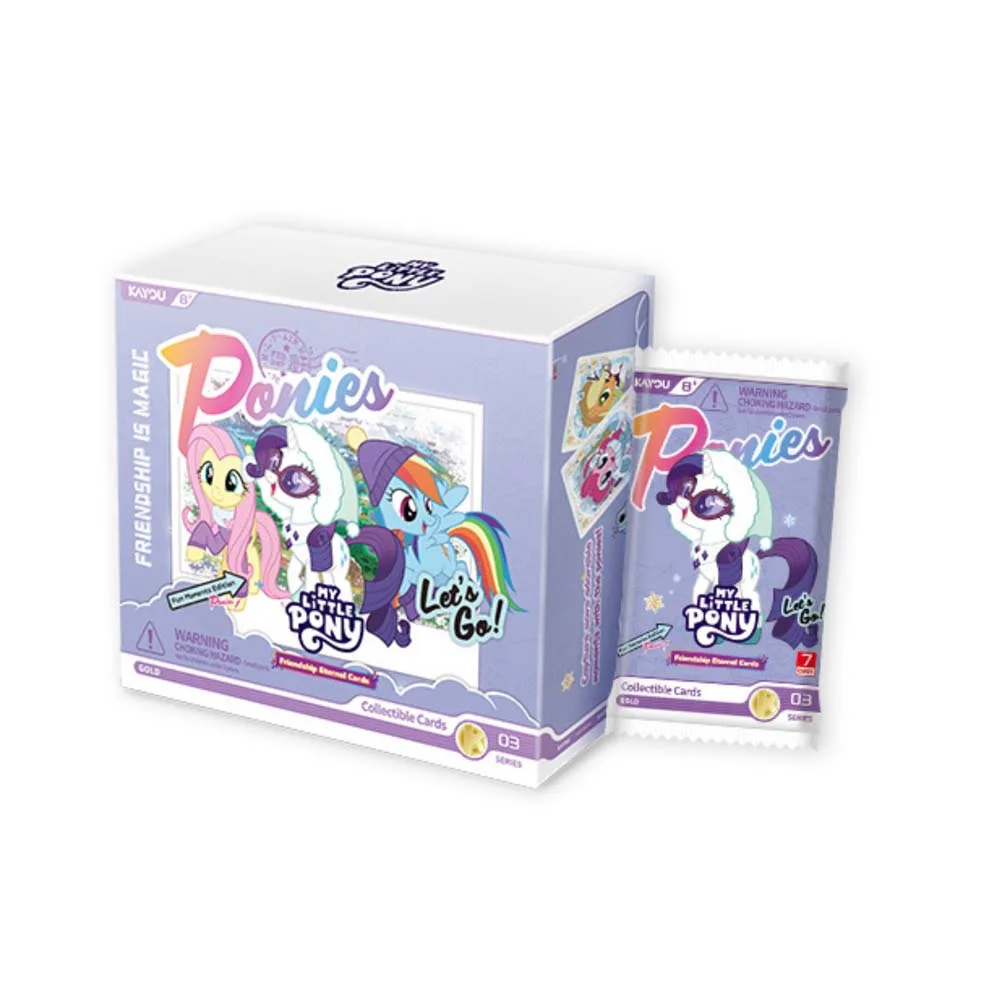
KAYOU My Little Pony Fun Moments 3 explained: the 148-card checklist across nine rarity tiers, the pack ratio KAYOU prints, the chase tiers, and how the NA and SEA boxes differ.