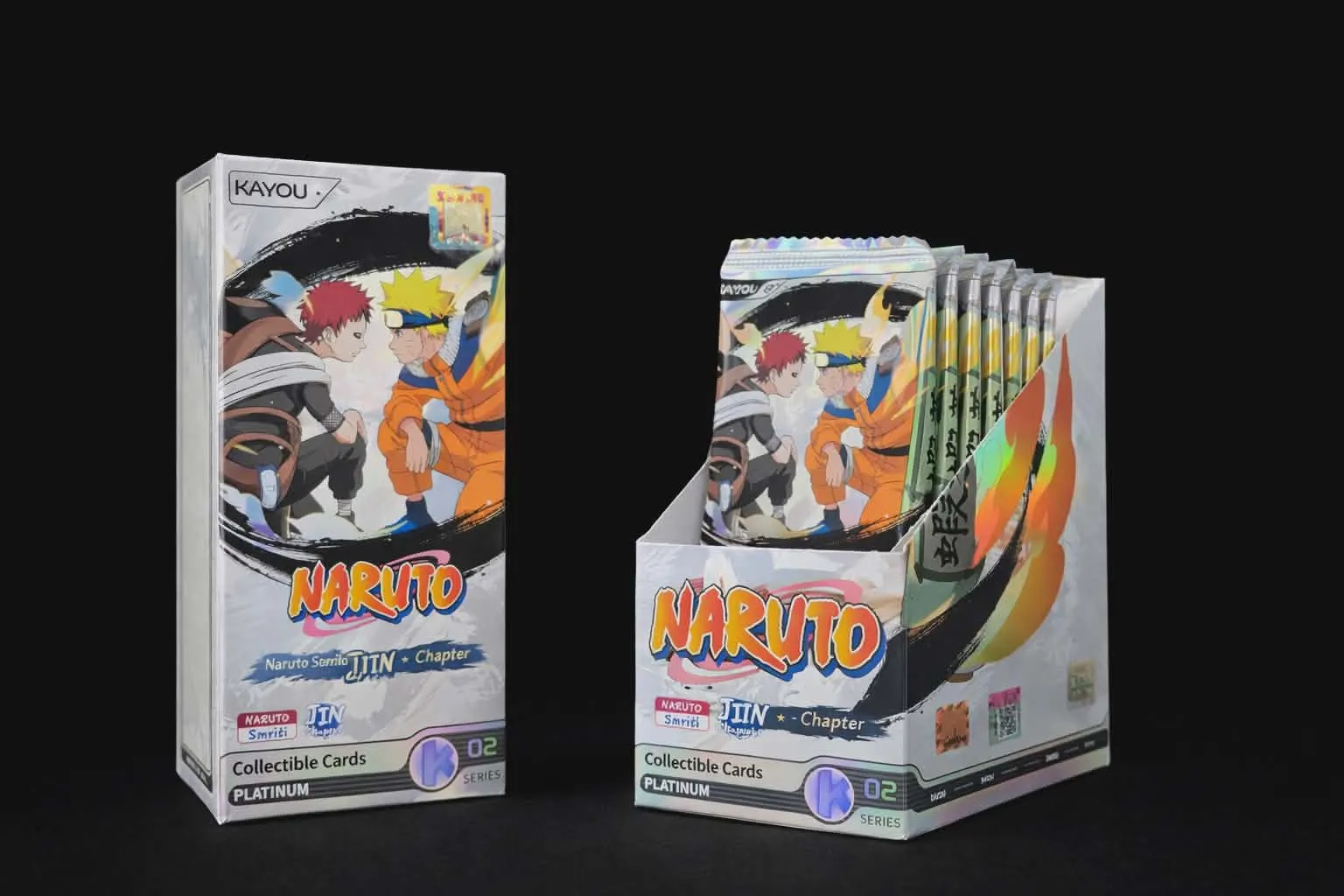
Shop this guide
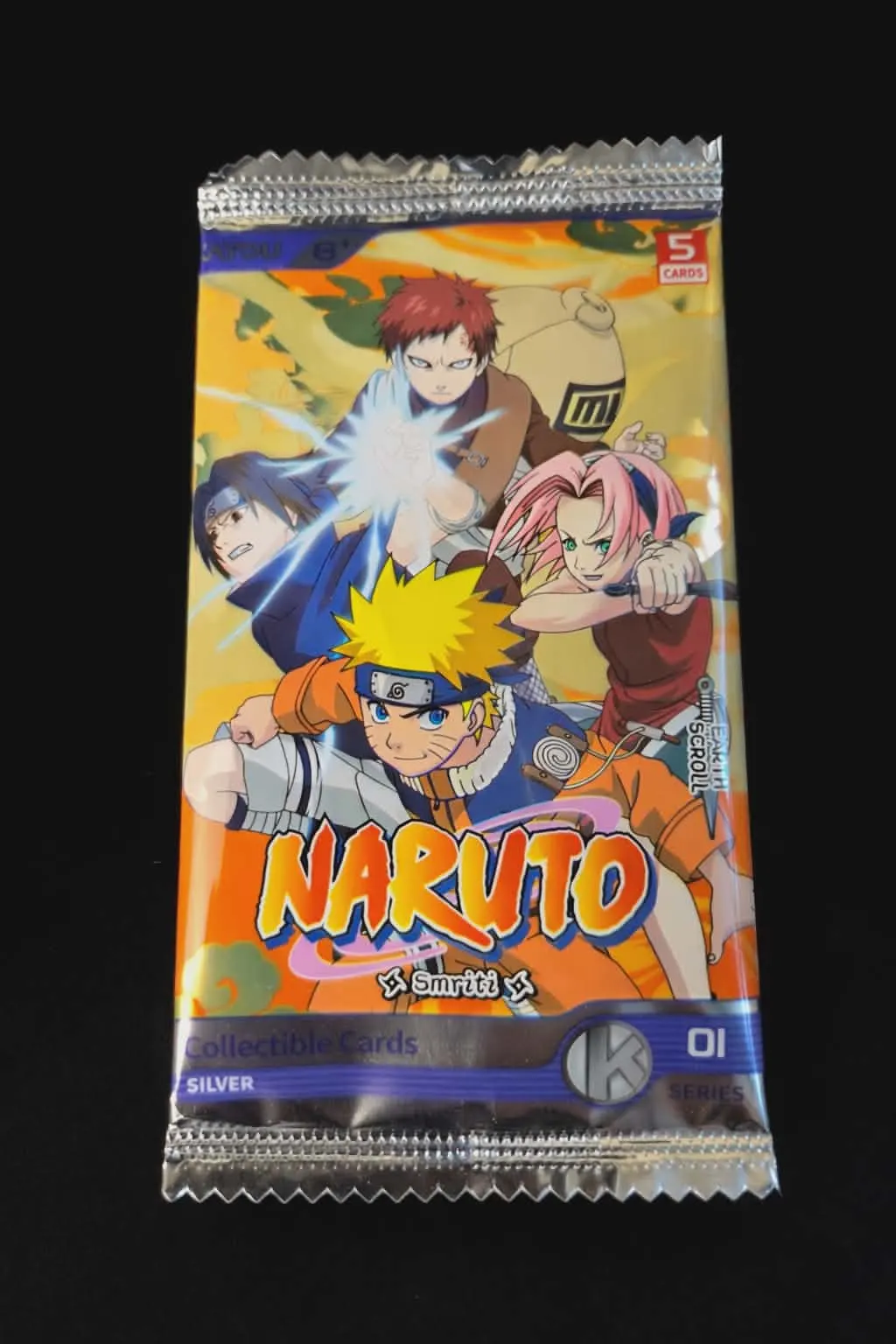
Live price & stock · dispatched from NSW.
Quick Answer
KAYOU Naruto rarity on the English boxes we stock climbs R, SR, SSR and UR, then a group of chase tiers: AR, MR, BP, SP, SE and CR. Jin Chapter boxes print 10 or 11 tiers, with SE on top and a PTR parallel in every pack, while Earth Scroll prints 8, topped by CR, SP or Diamond-UR. Chinese boxes add codes such as TR, OR, GP and NR that none of these boxes contain. A code tells you how scarce a card is, not what it is worth or how strong it is.
Every KAYOU Naruto rarity code at a glance
Last reviewed 22 September 2026 against the manufacturer-printed rarity pools on the retail boxes we stock.
These are the codes you can pull from the four English sets we stock: Jin Chapter Series 1 and 2, and Earth Scroll Series 1 and 2. R to UR is a fixed ladder. Above UR the order differs by set, so the chase tiers below are listed roughly in the order the boxes print them, and codes from different sets are not ranked against each other. Looking for the rarest individual cards rather than tiers? The rarest KAYOU Naruto cards list covers those.
| Code | Commonly read as | Found in | Card types | How often per sealed box | Example card |
|---|---|---|---|---|---|
| R | Rare | Every set we stock | 50 | Multiple in every pack | Base character cards |
| SR | Super Rare | Every set we stock | 20 | At least one in every pack | Base foil character cards |
| SSR | Super Super Rare (also Super Secret Rare) | Every set we stock | 23 to 25 | About 9 per SEA Earth Scroll box; from a shared slot in Jin Chapter | Naruto Uzumaki "Sexy Jutsu" SSR (NRSA01-SSR-021) |
| PTR | Parallel Texture Rare (also Poster Rare) | Jin Chapter Series 1 and 2 | 20 | One in every pack | Any of the 20 PTR designs |
| UR | Ultra Rare (also Ultimate Rare) | Every set we stock | 15 | Variable: 4 of 30 packs in Earth Scroll Series 1 SEA, 4 of 20 in the NA box, otherwise from a shared slot | UR hits of Naruto and Sasuke |
| PU | Parallel Ultra | Jin Chapter Series 1 and 2 | 8 | Only in the wide slot, not guaranteed | PU hits of the main cast |
| AR | Art Rare | Jin Chapter Series 2, Earth Scroll Series 1 and 2 | 10 | Only in the wide slot, not guaranteed | Gaara AR (NRSA02-AR-007) |
| MR | Mega Rare | Every set we stock | 4 to 7 | Only in the wide slot, not guaranteed | MR hits of Naruto, Kakashi or Minato |
| Diamond-UR (◇UR) | Diamond UR | Earth Scroll Series 2 | 4 | Only in the wide slot, not guaranteed | Itachi Diamond-UR |
| BP | Battle Premium | Jin Chapter Series 1 and 2 | 7 | Only in the wide slot, not guaranteed | Naruto BP (NRSA01-BP-001) |
| SP | Special | Jin Chapter Series 1 and 2, Earth Scroll Series 1 | 4 | Only in the wide slot, not guaranteed | Kakashi Hatake SP (NRSA01-SP-004) |
| CR | Comic Rare in Earth Scroll (Chinese lists read it as Cloud Rare) | Earth Scroll Series 1 and 2 | 4 | Only in the wide slot, not guaranteed | Itachi Uchiha CR (NREA02-CR-003) |
| SE | Special Edition | Jin Chapter Series 1 and 2 | 4 | Only in the wide slot, not guaranteed | Naruto Uzumaki SE (NRSA01-SE-002) |
The "commonly read as" names are how collectors usually expand each code, and KAYOU's own labels vary by release. KAYOU's official Jin Chapter Series 3 page reads AR as Amber Rare, MR as Miracle Rare, BP as Brush Rare and PU as Parallel Universe, and the Ninja Age tier list reads PTR as Platinum Rare. Go by the printed code, whatever name a listing gives it. The Jin Chapter Series 3 guide and the Ninja Age guide list those labels.
"The wide slot" is the one card position in some packs that can return a top tier. The retail box prints how many packs carry that slot, but not how the slot splits between the tiers inside it.
For what any of these cards are worth, go to the KAYOU Naruto card list and price guide. It sets out every English series card by card with the rarity and value tier for each one.
Common rarities: R, SR and SSR
R (Rare) cards are in every pack, every time. There are 50 R card types in each English set we stock, and they make up the bulk of any opening. R cards cover a wide range of characters and artwork, and binder collectors rely on them heavily.
SR (Super Rare) cards turn up at least once in every pack of every box we stock.
SSR is read as Super Super Rare or Super Secret Rare. Either way it sits above SR and below UR. In both SEA Earth Scroll boxes, 9 of every 30 packs carry an SSR, so a sealed box gives you about nine. In Jin Chapter an SSR comes from a slot it shares with other tiers. An SSR is a good pull, but it is not a chase-tier pull.
Parallels: PTR and PU
PTR is commonly read as Parallel Texture Rare, and some Chinese lists call it Poster Rare. It is a parallel tier with a textured parallel finish. In the Jin Chapter boxes we stock, one PTR comes in every pack, with 20 designs to find. Because every pack carries one, a PTR is a certainty rather than a chase. Earth Scroll has no PTR tier.
PU (Parallel Ultra) is Jin Chapter's second parallel tier, with 8 designs in each Jin set. Unlike PTR it only comes from the wide slot (3 in 10 packs in Series 1, 2 in 10 in Series 2), so it is not guaranteed.
UR: where hits start, plus TR, HR, ZR and TGR
Collectors count UR and above as a hit.
UR is read as Ultra Rare or Ultimate Rare. It sits above SSR and below the chase tiers. There are 15 UR card types in each English set we stock. In Earth Scroll Series 1, 4 of every 30 SEA packs and 4 of every 20 NA packs carry a fixed UR. In Jin Chapter and Earth Scroll Series 2 a UR only comes from a variable slot, so treat one as a strong result rather than a guaranteed pull.
That does not make every UR equal. A UR of a minor character can trade well below a UR of Naruto, Sasuke or Itachi. The code gives you the scarcity bracket, and character demand and artwork do the rest.
TR and HR do not appear in any of the four English boxes we stock. TR cards are semi-transparent, with chibi character artwork that stands out immediately. In the Chinese range, HR is a hologram-finish tier locked to Tier 4 boxes.
ZR and TGR are Chinese-market tiers, tied to particular Chinese box tiers and waves. ZR cards are rainbow-coloured, and TGR, like TR, is a semi-transparent chibi design. Neither is on the checklist for any English box we stock.
Chase tiers in English boxes: AR, MR, BP, SP, SE, CR and Diamond-UR
These are the tiers the wide slot can return. Not every set includes every code. OR is a Chinese-only tier.
AR (Art Rare) is the full-art tier, with 10 designs in Jin Chapter Series 2 and both Earth Scroll sets. More on it in the next section.
MR (Mega Rare) holds 6 card types in Jin Chapter Series 1, 7 in Series 2 and 4 in each Earth Scroll set. In Jin Chapter Series 1, MR and UR cards of Naruto, Kakashi and Minato are the most-chased designs.
BP (Battle Premium) cards use a brush-ink art treatment. There are 7 BP types in both Jin Chapter sets, and collectors chase them as binder centrepieces rather than ordinary foils.
SP (Special) is the stained-glass tier in both Jin Chapter sets, and it holds just 4 card types wherever it appears. In Jin Chapter Series 1 those four are Naruto, Sasuke, Sakura and Kakashi.
SE (Special Edition) is the top of the SEA Jin Chapter ladder, with 4 card types in each set. Series 1's four are the "Interlude Theater" scene cards of Sasuke, Naruto, Zabuza and Haku. Some Chinese SE waves were serial-numbered, and sources disagree on the print limits. The SEA boxes we stock do not print a serialised tier, so do not buy or sell an English SE on a serialisation claim.
CR (read as Comic Rare in Earth Scroll) appears in both Earth Scroll sets with 4 card types each, and it is one of Earth Scroll's top pulls.
Diamond-UR (◇UR) is Earth Scroll Series 2's advertised top pull. It has 4 designs, including Itachi, and takes the slot Series 1 gave to SP. It only comes from the variable slot in 6 of every 30 packs.
Want a specific chase card rather than opening for one? See Naruto chase cards in Australia.
What AR actually means
AR is the full-art tier: the card is given over to full-art styling rather than the standard layout of an R or SR.
AR sits in the scarce top group in every set that has it. In Jin Chapter Series 2 it only comes from the wide slot, which the box prints in 2 of every 10 packs. In the Earth Scroll sets it shares a variable slot with other tiers: MR, CR and SP in Series 1 (plus UR and SR in the NA box, or R in the SEA box), and UR, Diamond-UR, MR, CR and R in Series 2.
The headline AR cards are Gaara AR (NRSA02-AR-007) in Jin Chapter Series 2 and the connected Naruto and Sasuke AR pair in Earth Scroll Series 2. On sold comps AR is Jin Chapter Series 2's most valuable tier, led by Gaara and Sasuke. For what those cards currently fetch, see Jin Chapter Series 2's most valuable cards or Earth Scroll Series 2's most valuable cards.
CR, SP and MR: the three codes people confuse most
CR appears in both Earth Scroll sets with 4 card types each. Itachi Uchiha CR (NREA02-CR-003) is the Series 2 chase, and Gaara CR (NREA01-CR-004) leads Series 1 (see Earth Scroll Series 1's most valuable cards). The usual mistake: people read that CR is Chinese-exclusive and think they cannot pull one in Australia. In Earth Scroll, you can. You will not find CR in Jin Chapter.
SP is in both Jin Chapter sets and Earth Scroll Series 1, always at 4 card types. Earth Scroll Series 2 dropped SP and put Diamond-UR in that slot instead.
MR is in every English set we stock. In Jin Chapter it has more card types than SP (6 or 7 against 4), and SP sits above MR on the Jin Chapter ladder. The box prints one shared slot for PU, MR, BP, SP and SE and does not split it by tier, so there are no printed odds for either tier. In Earth Scroll Series 1, MR, SP and CR each hold four designs.
To confirm which one you have, read the card number (see below).
Chinese-edition rarity tiers
KAYOU Naruto started in China, sold in numbered box tiers (Tier 1 to Tier 4, plus Tier 2.5 and EX packs) and released in waves. New codes were added wave by wave, which is why the Chinese-market list is so much longer than the English one. One commonly shared community list orders the Chinese codes like this, lowest to highest. Sources differ on where ZR and TGR sit, and the order does not carry over to English boxes.
| Rarity code | Commonly read as / what it is | Tier category |
|---|---|---|
| R | Rare | Common |
| SR | Super Rare | Common |
| SSR | Super Super Rare | Common hit |
| TR | Semi-transparent chibi card | Hit |
| HR | Hologram card, Tier 4 boxes | Hit |
| ZR | Rainbow-colour card | Mid chase |
| TGR | Semi-transparent chibi card | Mid chase |
| UR | Ultra Rare | Chase |
| OR | Over Rare | Chase |
| AR | Art Rare | Chase |
| SLR | Rainbow-finish card, Tier 4 boxes and EX packs | Chase |
| SP | Special | Chase |
| CP | Gold card, Itachi Cloud Box only | Chase (tier-exclusive) |
| GP | Gold card, Tier 1 boxes from Wave 2 | Chase (tier-exclusive) |
| MR | Mega Rare | High chase |
| CR | Tier 2 boxes from Wave 2 | High chase (tier-exclusive) |
| NR | Rainbow-finish card, Tier 3 boxes from Wave 2 | High chase (tier-exclusive) |
| BP | Battle Premium | High chase |
| SE | Special Edition | Top-tier chase |
Later Chinese waves also added PTR and PU, the two parallel codes you now see in English Jin Chapter boxes.
Several Chinese codes are locked to specific box tiers, including CP, GP, CR and NR. Some tier-locked codes, CR in Earth Scroll and BP and SE in Jin Chapter, were later printed in English boxes, so a CR you pull in Australia is an Earth Scroll CR. If you copy a code list off a Chinese checklist, it will not match an English pull.
Which codes each box can produce
The edition and the set printed on the box decide the code list inside.
| Box | Format | Tiers | Scarcest tiers (4 designs) |
|---|---|---|---|
| Jin Chapter Series 1 (SEA) | 10 packs of 5 | 10: R, SR, SSR, PTR, UR, PU, MR, BP, SP, SE (158 card types) | SE, SP |
| Jin Chapter Series 2 (SEA) | 10 packs of 5 | 11: the Series 1 ladder plus AR (168 card types) | SE, SP |
| Earth Scroll Series 1 (NA or SEA) | 20 packs of 8 (NA) or 30 packs of 5 (SEA), same 131-card pool | 8: R, SR, SSR, UR, AR, MR, SP, CR | MR, SP, CR |
| Earth Scroll Series 2 (SEA) | 30 packs of 4 | 8: R, SR, SSR, UR, AR, MR, Diamond-UR, CR (132 card types) | MR, Diamond-UR, CR |
| Earth Scroll Series 2 (NA) | 20 packs of 7 | 8: the same codes as the SEA box (132 card types per KAYOU's US site) | MR, Diamond-UR, CR |
None of TR, HR, ZR, TGR, OR, SLR, CP, GP or NR appear in these boxes. If a video shows one of those, it came from a Chinese box or a different English release. For the two Earth Scroll Series 1 editions the choice is about pack size, not what you can pull. For Earth Scroll Series 2, KAYOU lists the same 132 types and 8 tiers for the NA box, but one of its four Diamond-UR cards is a US exclusive, so the two card lists are not identical. The Earth Scroll Series 2 box guide compares the two boxes. The KAYOU Naruto SEA vs NA guide explains the two English editions, and Chinese vs English KAYOU Naruto cards covers the Chinese side.
Match the codes to the product you buy:
- Cheapest way to see the ladder: a few Earth Scroll Series 2 booster packs, or browse all Naruto booster packs. The Earth Scroll Series 2 Starter Bundle pairs the box with four extra packs.
- A guaranteed PTR in every pack: the Jin Chapter Series 1 box, one in each of its 10 packs. That is a guaranteed parallel, not a guaranteed UR-or-better hit. The Series 2 box is the lower-priced of the two Jin Chapter boxes we stock, and the Jin Chapter Series 1 vs 2 comparison covers the differences.
- Both lines in one order: the Premium Collector Bundle, three sealed SEA English boxes: Jin Chapter Series 1, Jin Chapter Series 2 and Earth Scroll Series 2.
Earth Scroll is the usual first box, with a shallower ladder than Jin Chapter. Browse Jin Chapter booster boxes or Earth Scroll booster boxes, or compare every box on format at Naruto booster boxes. The best KAYOU Naruto set guide covers who each line suits, and the best KAYOU Naruto booster box guide compares them for chase pulls. All stock is authentic sealed product dispatched from the Central Coast, NSW.
How many of each rarity are in a box
KAYOU prints an appearance probability on the retail boxes we stock, and publishes the NA Earth Scroll Series 2 table on its US site. Here is what those tables say:
| Box | Format | What every box delivers | Packs with the variable slot, and what it can return |
|---|---|---|---|
| Jin Chapter Series 1 (SEA) | 10 packs of 5 | One PTR and at least one SR in every pack | 3 in 10 packs: SR, SSR, UR, PU, MR, BP, SP or SE (of the other 7, five draw SR, SSR or UR and two carry a second SR) |
| Jin Chapter Series 2 (SEA) | 10 packs of 5 | One PTR and at least one SR in every pack | 2 in 10 packs: SSR, UR, PU, MR, BP, AR, SP or SE (the other 8 draw SR, SSR or UR) |
| Earth Scroll Series 1 (SEA) | 30 packs of 5 | One SR in every pack, SSR in 9 of 30, UR in 4 of 30 | 17 in 30 packs: R, AR, MR, SP or CR |
| Earth Scroll Series 1 (NA) | 20 packs of 8 | Two SSR and a UR in 4 of 20 packs, three SR in the other 16 | 16 in 20 packs: SR, UR, MR, SP, AR or CR |
| Earth Scroll Series 2 (SEA) | 30 packs of 4 | One SR in every pack, SSR in 9 of 30 | 6 in 30 packs: R, UR, Diamond-UR, AR, MR or CR |
| Earth Scroll Series 2 (NA) | 20 packs of 7 | Three R, two SR and an SSR in every pack | Every pack: either a UR or a slot that can return SSR, Diamond-UR, AR, MR or CR |
The printed rates are calculated across total production, so individual boxes vary around them and duplicates are normal. None of these boxes guarantees an SE, SP, CR or any other single top tier. The NA Earth Scroll Series 2 odds come from KAYOU's US site rather than the box we hold, and they are a separate table, so the SEA figures do not carry across.
The Earth Scroll Series 2 table is walked through in KAYOU Naruto pull rates and box odds explained.
Serialised cards sit outside the code system
A serialised card carries a printed number showing how many copies exist. That is a separate axis from the letter code: a card can carry both a rarity code and a serial, and the serial is what drives the top of the market.
The SEA sealed boxes we stock do not print a serialised tier. Numbered cards are a North American edition and special-promo feature. For what they are and how many exist, see the KAYOU Naruto serialised cards guide.
Reading the code on a card you have already pulled
The tier code is printed on the card, and the card number tells you the set, tier and design. Take NRSA01-SE-002: NRSA01 is Jin Chapter Series 1 (the NA Heaven Scroll print uses the same NRSA01 numbers), SE is the tier and 002 is the design. NRSA02 is Jin Chapter Series 2, and NREA01 and NREA02 are Earth Scroll Series 1 and 2.
If a finish looks ambiguous, trust the number over the shine, and match it against the set list in the card list and price guide. The one exception is Diamond-UR, whose cards carry UR numbers (NREA02-UR-001 to 004), so check the diamond finish as well.
Counterfeits tend to claim a high tier and fall short on the finish. Check that the number matches a real design on the set list, that the foil or texture finish is clean for the tier, and that the print and card stock are sharp. On sealed product, look for the KAYOU security hologram. The full check is in how to spot fake KAYOU Naruto cards, and the KAYOU Naruto card condition guide covers grading your own copy.
Is KAYOU Naruto a TCG?
People search "Naruto TCG rarity" as a catch-all. KAYOU Naruto has no rules or tournaments, so a rarity code only tells you how scarce a card is. The playable Naruto games (Bandai's retired card game and Naruto Mythos) use their own rarity systems. The full answer is in is KAYOU Naruto a TCG or a collectible.
Rarity vs character: what should you chase?
For most collectors, the character matters more than the code. A collection built around the characters you love, such as Kakashi, Minato or Rock Lee, is one you will display and enjoy. A collection built purely around the top tier is expensive, and results vary.
A mid-tier card of a top-demand character often outsells a high-tier card of a minor one. The most valuable KAYOU Naruto characters guide covers the character side.
- Chase rarity if you are completing a full set checklist or pulling for trade value.
- Chase characters if you are building binders, making display sets or buying a gift.
If you want specific characters at R and SR, single packs can be more efficient than chasing box hits. The KAYOU Naruto cards buying guide maps out the format trade-off, and the KAYOU Naruto glossary has quick definitions of other terms. For whether a box is worth opening at all, read are KAYOU Naruto cards worth it. Ready to buy? Shop KAYOU Naruto cards in Australia.
Rarity code quick-reference card
| Code | One-line meaning |
|---|---|
| R | Base tier, multiple in every pack |
| SR | At least one in every pack |
| SSR | First step up, several per box |
| PTR | Parallel finish, one in every Jin Chapter pack |
| UR | Where hits start |
| PU | Jin Chapter parallel tier, wide slot only |
| AR | Full-art chase tier |
| MR | Four to seven designs, wide slot only |
| Diamond-UR | Earth Scroll Series 2's advertised top pull |
| BP | Brush-ink art chase, Jin Chapter only |
| SP | Four-design chase tier, stained glass in Jin Chapter |
| CR | One of Earth Scroll's top pulls, four designs |
| SE | Top of the SEA Jin Chapter ladder |
| TR, HR, ZR, TGR, OR, SLR, CP, GP, NR | Not in the English boxes we stock |
Frequently Asked Questions
What does AR mean on a KAYOU Naruto card?
AR is a full-art rarity tier, read as Art Rare. It appears in Jin Chapter Series 2 and both Earth Scroll sets, with 10 designs in each, and only comes from the pack slot that can return a top tier. The card list and price guide shows what individual AR cards are currently worth.
What does SSR mean on a KAYOU Naruto card?
SSR is read as Super Super Rare or Super Secret Rare. It sits above SR and below UR, so it is a good pull but not a chase-tier one. In the SEA Earth Scroll boxes, 9 of every 30 packs carry an SSR, so a sealed box gives you about nine.
What does UR mean in KAYOU Naruto?
UR is read as Ultra Rare or Ultimate Rare. It sits above SSR and below the chase tiers such as AR, MR, SP, SE and CR, and collectors treat UR and above as a hit. Each English set we stock has 15 UR designs, and a UR is not guaranteed in every box.
Which rarity codes appear in English KAYOU Naruto boxes?
In the boxes we stock, Jin Chapter Series 1 prints R, SR, SSR, PTR, UR, PU, MR, BP, SP and SE, and Series 2 adds AR. Earth Scroll prints R, SR, SSR, UR, AR, MR and CR, plus SP in Series 1 and Diamond-UR in Series 2. TR, HR, ZR, TGR, OR, SLR, CP, GP and NR do not appear in any of the four English boxes we stock.
How many rarities does KAYOU Naruto have?
The Chinese range runs more than 20 codes, added wave by wave. The English boxes we stock print far fewer: 10 tiers in Jin Chapter Series 1, 11 in Series 2 and 8 in each Earth Scroll set. Check the set before assuming a code exists in it.
Can you pull a CR from an English box?
Yes, from Earth Scroll. Both Earth Scroll sets print a CR tier with four designs, including Itachi Uchiha CR in Series 2 and Gaara CR in Series 1. CR does not appear in Jin Chapter, and the Chinese tier-box CR is a separate Chinese-market card.
What is the rarest KAYOU Naruto rarity?
In the SEA Jin Chapter boxes we stock, SE sits at the top, with SP just below it, at four designs each. In Earth Scroll, the four-design tiers are CR, MR and SP in Series 1, and CR, MR and Diamond-UR in Series 2. For the individual cards at the top of the market, see the rarest KAYOU Naruto cards list.
What does SP mean, and is it rarer than MR?
SP stands for Special and always has four designs in the sets that carry it. On Jin Chapter boxes SP ranks above MR, and MR has more designs (six or seven). The box prints one shared top slot without splitting it by tier, so there are no exact odds for either and neither is guaranteed.
What is a PTR card?
PTR is commonly read as Parallel Texture Rare, and some Chinese lists call it Poster Rare. In the Jin Chapter Series 1 and 2 boxes we stock, one PTR comes in every pack, with 20 designs to collect. Earth Scroll has no PTR tier.
Does a higher rarity code always mean a more valuable card?
No. Character demand often matters more than the code, so a mid-tier card of a headline character can outsell a top-tier card of a minor one. Edition and condition also move the figure, and serialised cards sit on a separate axis entirely. Treat the code as a starting point, then check the card in the price guide.
How do I find the rarity code on my card?
The tier code is printed on the card and is part of the card number. In NRSA01-SE-002, NRSA01 is Jin Chapter Series 1, SE is the tier and 002 is the design. Diamond-UR cards carry UR numbers, so check the diamond finish for that tier.
How many high-rarity cards should I expect from one box?
It depends on the box. Jin Chapter Series 2 prints the variable top-tier slot in 2 of every 10 packs and Earth Scroll Series 2 in 6 of every 30, and neither guarantees any single top tier. The printed rates describe total production, so buy the box you want to open rather than one you are counting on to pay for itself.
Keep Exploring
Continue into the most relevant buying pages and cornerstone guides from this topic.
Landing
Naruto Chase Cards Australia
Which chase tiers to hunt, which sealed boxes pull the deepest, and where to buy chase-card product locally.
Chase the raresReference
KAYOU Naruto Card List & Price Guide
Every series' card counts per rarity with honest A$ value bands: the lookup reference for pricing pulls.
Open the price guideSerialised
KAYOU Naruto Serialised Cards Guide
What numbered cards mean, how rare they really are, and which are worth chasing.
Read the serialised guideBrand hub
KAYOU Naruto Cards Australia
The whole line at a glance — Jin Chapter and Earth Scroll, every series and edition, with sealed boxes, packs and bundles in stock.
Explore KAYOU NarutoWritten By
Cottier TCG Editorial Team
Bringing you accurate KAYOU collecting news and buying guides for Australian collectors. Based in the Central Coast, NSW Australia.
Collectors Club
Enjoyed this guide? Get the next drop first.
Join the Collector's Club for restock alerts, new collector guides, and early access to KAYOU boxes before they sell out.
New members get 10% off your first order
Keep Reading
Other stories you might enjoy from our experts.
Most Valuable KAYOU Naruto Earth Scroll Series 2 Cards: Itachi CR and the Real Chase
Itachi CR sold 23 times at a A$384 median, from a cheap box. The Diamond UR the box advertises is a A$50 card. Every Earth Scroll Series 2 card worth money, from completed eBay AU sales.
Gaara CR A$104, Neji CR A$84, and a ten-card AR tier that reliably sells for A$70 a card. The Earth Scroll Series 1 cards worth keeping, priced from completed eBay AU sales.
Most Valuable KAYOU Naruto Jin Chapter Series 3 Cards: ASP, SE and the Serialised Ladder
ASP /99 cards from A$1,535 raw, SE /220 up to A$3,978, and the AR /777 and BP /999 serials most boxes actually produce. Every Series 3 card worth money, from completed eBay AU sales.