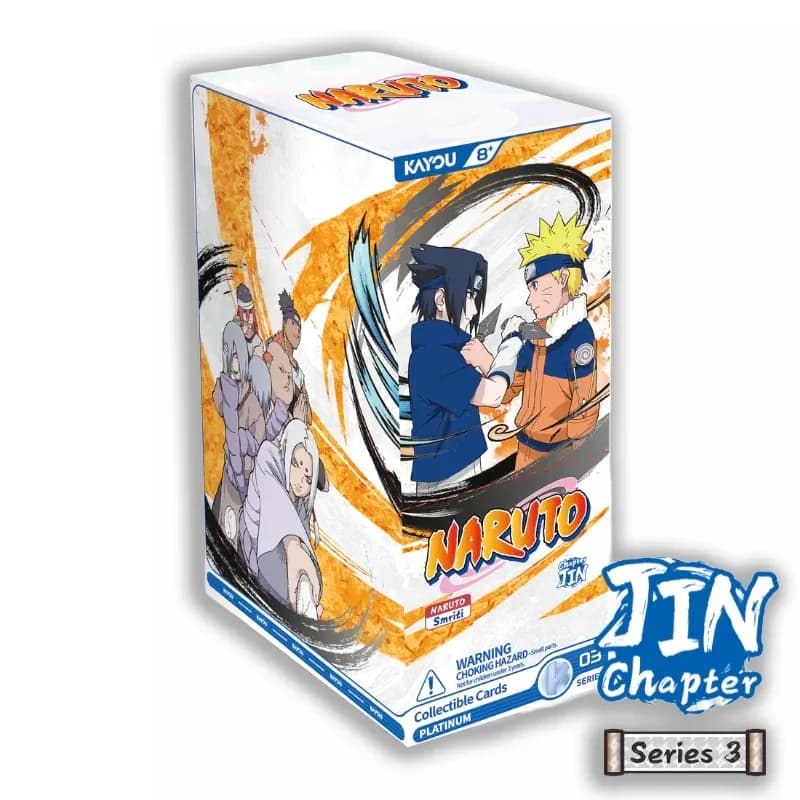
Shop this guide
Live price & stock · dispatched from NSW.
If you have spent any time in the KAYOU Naruto hobby, you have seen the photos: a card with a tiny stamped number in the corner, something like 042/099 or 07/777. Collectors call these serialized cards, and they sit in a different category to the rest of the rarity ladder — not just rare, but individually numbered out of a fixed, known print run.
Here is the part most guides skip: not every KAYOU Naruto box has them. Serialized cards are one of the biggest sources of confusion in the whole hobby, because the sets that print them and the sets that don't sit right next to each other on the shelf, sometimes in the same product line. This guide is the single reference for what a serialized card actually is, exactly which KAYOU Naruto products carry them, how they differ from a plain low-odds chase pull, and whether they are worth going after.
What a serialized KAYOU Naruto card actually is
A serialized card (also called a serial-numbered card or a numbered card) has a stamped or printed fraction somewhere on the card face — usually a lower corner — that shows exactly where it sits in a capped print run. You will see it written as something like:
- 042/099
- 07/777
- 150/220
- 003/009
The number on the left is the unique copy you are holding. The number on the right is the total number ever printed of that specific card. A card stamped 042/099 is the 42nd copy out of only 99 that will ever exist.
That is the whole appeal in one sentence: a known, fixed ceiling on supply. A regular SR or SSR might have a print run in the tens of thousands and nobody outside KAYOU knows the real number. A serialized card tells you the exact count, in your hand, on the card itself.
Serialized is not a rarity tier on its own — it is a modifier stamped on top of an existing tier. In the products that carry a numbered chase, tiers such as AR, BP, SE, and ASP are the ones that get the serial treatment; the base tier and rarity ladder still work the way our rarity guide describes, the numbered stamp is just an extra layer of scarcity sitting on top of it.
Which KAYOU Naruto products actually have serialized cards
This is the question that causes the most confusion, so here is the honest, line-by-line answer.
Serialized cards in KAYOU Naruto are a North American (NA) edition feature. The South-East Asia (SEA) English edition — which is what most of the sealed product on Australian shelves actually is — does not print a serialized tier at all, in any line. If you have opened SEA-edition packs and never pulled a numbered card, that is not bad luck. It is not in the pool.
| Line & edition | Serialized tier? | Detail |
|---|---|---|
| Jin Chapter Series 1 (SEA) | No | SEA pack pool does not include a numbered tier |
| Jin Chapter Series 2 (SEA) | No | Same as S1 — no numbered tier in the SEA print |
| Jin Chapter Series 3 (NA) | Yes | Five serialized tiers, pulled from the 12 standard packs (see below) |
| Earth Scroll Series 1 (NA & SEA) | No | Neither edition of Earth S1 carries a serialized tier |
| Earth Scroll Series 2 (SEA) | No | Box prints an official Appearance Probability instead of a numbered chase |
| Heaven Scroll Series 1 (NA-only, not stocked by us) | No serialized tier reported as of mid-2026 | A separate premium Smriti-branded line — see note below |
A few things worth spelling out from that table:
- Jin Chapter S1 and S2 — the boxes we stock for those series — are the SEA edition, and SEA does not carry a serialized tier in the Jin line at all. If you are opening S1 or S2 packs specifically hunting for a numbered card, you are chasing something that is not in that print.
- Jin Chapter Series 3 is the exception, because our S3 stock is the NA edition rather than SEA. That is the one Jin release on the site where serialized cards are actually in the pool — more on the specific tiers below.
- Earth Scroll doesn't carry a serialized tier in either edition. Earth Scroll Series 2 boxes print an official pull-rate breakdown (KAYOU's own "Appearance Probability" figures, read straight off the box), which is a different kind of transparency to a numbered print run — official odds, not a numbered chase.
- There is also a separate family of serialized NRSA promo cards (numbered to figures like /99 and /999) that turn up in some KAYOU releases — these are also NA/US-exclusive and are not part of the SEA product pool.
- Heaven Scroll Series 1 is a genuinely separate premium English line under KAYOU's "Smriti" branding, NA-only as of mid-2026, and not something we currently stock. No serialized tier has been reported for it as of writing — we are phrasing that carefully because it is a newer release and KAYOU has not published anything official either way.
If you want the plain-language version of why NA and SEA specs differ this much across pack count, card count, and rarity ladders — not just serialized cards — our SEA vs NA English cards explained guide covers the full breakdown.
Jin Chapter Series 3: the one line with serialized cards
Series 3 is the current premium release we stock, and it is genuinely the NA edition — a different product to the SEA-edition S1 and S2 boxes sitting next to it on the site. That edition difference is exactly why it is the only Jin release with a serialized chase.
Five tiers in Series 3 carry a serial number, all pulled from the 12 standard booster packs in a sealed box (not from the separate promo pack — see below):
| Tier | Numbered to | Reported designs |
|---|---|---|
| AR | /777 | ~7 |
| BP | /999 | ~6 |
| SE | /220 | 4 |
| ASP | /99 | 8 |
| Diamond ASP (◇ASP) | /9 | 8 |
Every figure in that table is distributor-reported, sourced from early NA distributor and retailer listings rather than an official KAYOU pull-rate sheet — KAYOU does not publish official pull rates for its Naruto releases. Treat them as product specs to understand the set, not as odds you are guaranteed out of any single box.
The Series 3 box also includes a separate sealed promo pack — a single promotional card, reported as either Naruto (PR-009) or Sasuke (PR-010), one at random per box. That promo pack is not serialized. No print-run cap has been reported for it, and it is a distinct bonus insert sitting apart from the five numbered tiers pulled from the regular packs. It is easy to assume the promo card is the big serialized chase in the box — it isn't.
For the full tier-by-tier rundown of Series 3's five numbered tiers — what each one looks like, how the print runs stack up against each other, and where to spot the serial stamp — see our dedicated deep-dive: Jin Chapter Series 3 serial-numbered cards guide. This hub covers the concept across every line; that guide covers Series 3's numbered cards specifically.
You can browse the current Jin Chapter Series 3 booster box listing for live stock and specs.
Serialized cards vs a low-odds chase pull
New collectors often lump "serialized" in with "just really rare," but the two are genuinely different kinds of scarcity, and the difference matters for how you think about chasing either one.
A low-pull-rate chase tier — something like an MR, or the PTR tier that KAYOU's Jin SEA boxes guarantee once per pack — is scarce because the odds of pulling that specific card are low. The print run behind it is not published or capped in any visible way; you are working from odds, not a hard number. (PTR, for what it is worth, is a real printed KAYOU rarity code — the PET-coated refractor tier, not a data error or a typo you will see repeated across guides.)
A serialized card is scarce because the supply itself is capped, and that cap is printed on the card. A Diamond ASP numbered to /9 will only ever have nine copies in existence, full stop — there is no version of pulling more of them into circulation later, the way a low-odds tier could theoretically keep turning up in future boxes.
That is the real distinction:
- Odds-based scarcity (MR, PTR, and similar unnumbered chase tiers): hard to pull, but the total supply is unknown and open-ended.
- Supply-based scarcity (serialized tiers): the odds of pulling one are still low, but the total supply is fixed and visible on the card itself.
Both are genuine chase cards. They just represent different kinds of "rare," and conflating them is where a lot of hobby confusion starts. For the full tier list and where each rarity code sits in the ladder, our rarity guide is the reference; for the specific cards that combine top rarity, character demand, and serialized scarcity into the biggest chases in the hobby, see rarest KAYOU Naruto cards.
Reading the number and checking it is real
Once you have a card you think is serialized, two things are worth checking: reading the number correctly, and confirming the card itself is genuine.
Reading the stamp. The serial number sits on the card face, usually in a lower corner, printed over or alongside the foil or texture treatment as a small fraction like 07/99. On the heavier textured tiers it can be genuinely hard to spot against a holographic background — tilt the card under good light and check along the bottom edge before you conclude a card has no number at all.
Checking it is genuine. Serialized cards are exactly the kind of card counterfeiters target, because a stamped number and a premium finish are both things a fake can attempt to replicate, and a buyer chasing a specific numbered card is often willing to pay more without checking closely first. Foil consistency, print sharpness, card stock weight, and the quality of the serial stamp itself are all things worth checking before you trust a numbered card is real, especially if you are buying a single on the secondary market rather than pulling it yourself from a sealed pack. Our how to spot fake KAYOU Naruto cards guide walks through the checks in detail — read it before buying a numbered single from anyone you don't already trust.
Are serialized cards worth chasing
There is no universal answer here, but there are consistent drivers behind why some serialized cards command more attention than others.
Run size. A smaller print run is a harder ceiling. A card numbered to /9 is a fundamentally different scarcity proposition to one numbered to /999, even within the same set and the same base tier.
Character. A numbered card of a major, widely collected character tends to draw more attention than the same tier and run size on a lesser-known character. Demand for the character and scarcity of the print run compound each other rather than acting independently.
Condition sensitivity. The premium finishes used on serialized tiers — heavy foiling, textured or lenticular treatments — tend to be more prone to scuffing and edge wear than a plain card. A numbered card that came out of the pack with a scratch across the foil is a different card, condition-wise, to the same card pulled clean. Sleeve it the moment you identify it, and get it into a top-loader or semi-rigid holder before it goes anywhere near a table full of other cards.
Grading potential. Because the supply is fixed and visible, a clean, pack-fresh serialized card is often a stronger long-term grading candidate than an unnumbered rarity of similar tier — condition and provenance both matter more when the total supply is a known quantity.
What we are not going to do here is put a dollar figure on any of this. Secondary-market prices for serialized cards move constantly, and a number that looks right this month is stale within a few. A serialized card can hold or build value over time — the fixed supply is a real, structural reason for that — but there is no guaranteed return, and nothing here should be read as investment advice. If you want to understand how collectors think about value and demand across the wider hobby, our rarest KAYOU Naruto cards post and the chase cards page go into more depth on what actually drives demand.
The honest framing: chase serialized cards because you like the idea of owning one of a known, fixed handful of copies — not because a guide told you it is a safe way to make money.
Frequently Asked Questions
Do SEA edition boxes have serialized cards?
No. The SEA (South-East Asia) English edition does not print a serialized tier in any KAYOU Naruto line we carry, including Jin Chapter Series 1 and Series 2 and both Earth Scroll series. Serialized cards are specific to the NA (North American) edition, and currently that means Jin Chapter Series 3 on our site.
What does a number like 042/099 mean on a card?
It is a serial stamp showing where that specific copy sits in a fixed print run. The number on the left is the individual copy — in this example, the 42nd — and the number on the right is the total number ever printed of that card, so 042/099 means that copy is one of only 99 that will ever exist.
Which KAYOU Naruto set has serialized cards?
Jin Chapter Series 3 (NA edition) is the set on our site with a confirmed serialized tier — five numbered tiers pulled from its regular booster packs. Jin Chapter Series 1 and Series 2 (SEA edition) and both Earth Scroll series do not carry a serialized tier.
Are serialized cards guaranteed in a box?
No. KAYOU does not publish official pull rates for its Naruto releases, and a serialized pull is a genuine chase card rather than a guaranteed hit. A box of a serialized-capable product may contain several numbered cards or none at all.
Is the promo pack card in a Jin Chapter Series 3 box serialized?
No. The sealed promo pack included in Series 3 boxes holds a single non-serialized promotional card (reported as either Naruto or Sasuke). It is a separate bonus insert, and no print-run cap has been reported for it — the five serialized tiers come from the 12 standard packs, not the promo pack.
How can I tell if a serialized card I am buying as a single is genuine?
Check the foil consistency, print sharpness, card stock, and the quality of the serial stamp itself, and buy from a seller who will stand behind authenticity. Serialized cards are a common counterfeit target because of the premium they command — our spot-fake guide covers the specific checks in detail.
Keep Exploring
Continue into the most relevant buying pages and cornerstone guides from this topic.
Landing
Naruto Chase Cards Australia
Which chase tiers to hunt, which sealed boxes pull the deepest, and where to buy chase-card product locally.
Chase the raresReference
KAYOU Naruto Card List & Price Guide
Every series' card counts per rarity with honest A$ value bands: the lookup reference for pricing pulls.
Open the price guideGuide
KAYOU Naruto Card Rarity Guide
Every rarity tier explained: read this before opening packs or buying singles.
Read the rarity guideBrand hub
KAYOU Naruto Cards Australia
The whole line at a glance — Jin Chapter and Earth Scroll, every series and edition, with sealed boxes, packs and bundles in stock.
Explore KAYOU NarutoWritten By
Cottier TCG Editorial Team
Bringing you accurate KAYOU collecting news and buying guides for Australian collectors. Based in the Central Coast, NSW Australia.
Collectors Club
Enjoyed this guide? Get the next drop first.
Join the Collector's Club for restock alerts, new collector guides, and early access to KAYOU boxes before they sell out.
New members get 10% off your first order
Keep Reading
Other stories you might enjoy from our experts.
Most Valuable KAYOU Naruto Earth Scroll Series 2 Cards: Itachi CR and the Real Chase
Itachi CR sold 23 times at a A$384 median, from a cheap box. The Diamond UR the box advertises is a A$50 card. Every Earth Scroll Series 2 card worth money, from completed eBay AU sales.
Gaara CR A$104, Neji CR A$84, and a ten-card AR tier that reliably sells for A$70 a card. The Earth Scroll Series 1 cards worth keeping, priced from completed eBay AU sales.
Most Valuable KAYOU Naruto Jin Chapter Series 3 Cards: ASP, SE and the Serialised Ladder
ASP /99 cards from A$1,535 raw, SE /220 up to A$3,978, and the AR /777 and BP /999 serials most boxes actually produce. Every Series 3 card worth money, from completed eBay AU sales.