Shop this guide
KAYOU Naruto Cards Australia
The whole line at a glance — Jin Chapter and Earth Scroll, every series and edition, with sealed boxes, packs and bundles in stock.
Explore KAYOU NarutoYou're holding a pack you just opened and something feels wrong. The foil looks dull. The colours seem off. Or you're on eBay looking at a sealed box priced so far below every other listing that you can't decide whether to pull the trigger. One collector on r/KayouNarutoCards put it plainly: "Are these real or fake? Need help asap please."
That anxiety is legitimate. Fake KAYOU Naruto cards do exist, counterfeit sealed boxes circulate on certain platforms, and the risk is real enough that it comes up regularly in collector communities. This guide walks you through how to spot fake KAYOU Naruto cards — and how to avoid the even more common mistake of calling a legitimate card fake when it's simply from a different regional edition. If you want a quick reference for what genuine sealed product looks like, our authentic KAYOU Naruto cards page is a useful benchmark.
Quick Answer
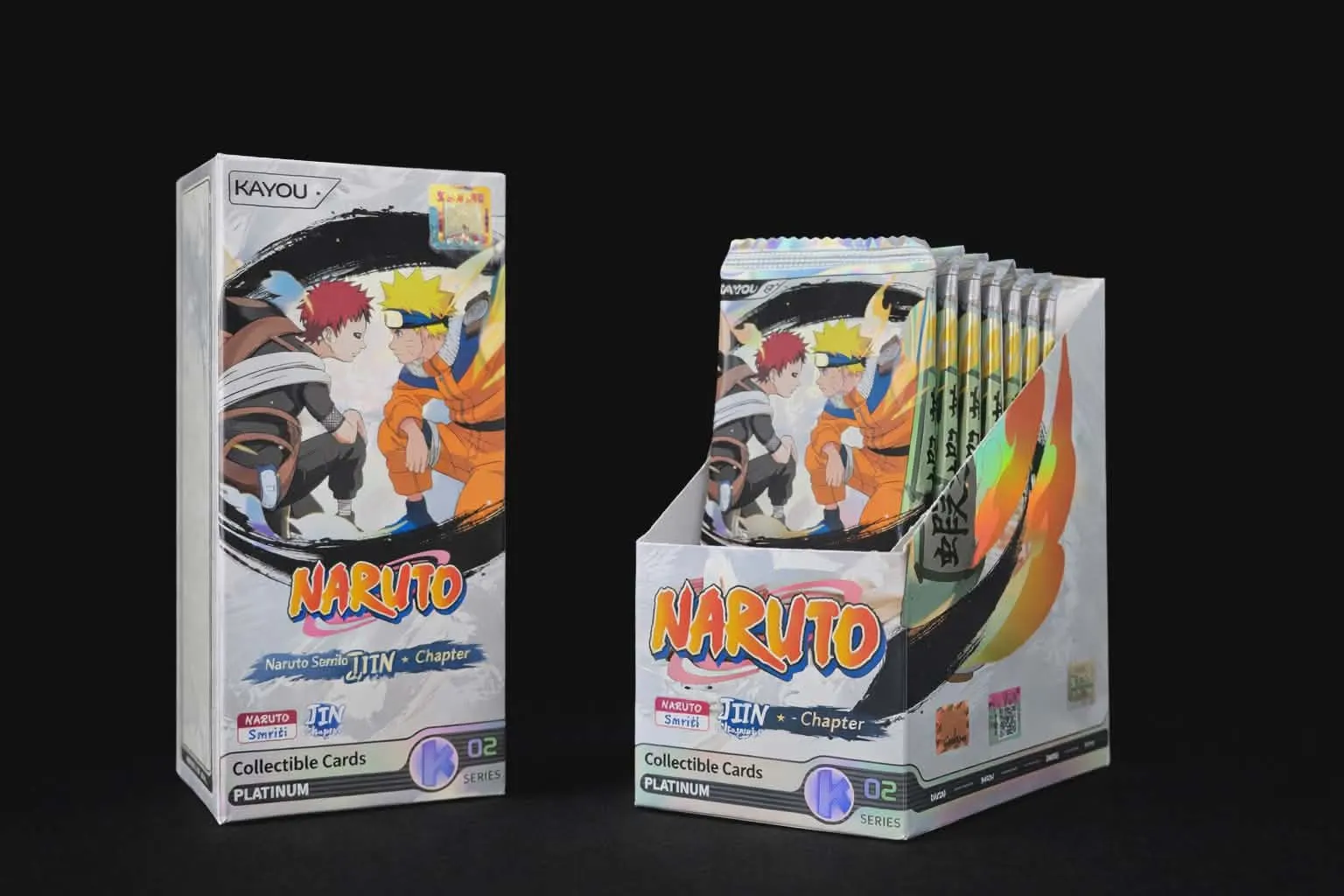
Genuine KAYOU Naruto cards have sharp, vibrant printing, crisp foil on hit cards, and firm card stock with a solid feel in hand. Fakes typically show washed-out or over-saturated colour, soft text edges, and noticeably flimsy stock. For sealed boxes, verify the pack count and cards-per-pack match the correct edition — and look for the official silver lenticular authenticity sticker on the box. The biggest source of false alarms isn't counterfeiting at all: it's regional edition confusion, where a legitimate SEA or NA edition box doesn't match what a buyer expected to see.
Are KAYOU Naruto cards real?
Yes. KAYOU Naruto cards are real, officially licensed Naruto collectible cards made by KAYOU (卡游), a Chinese card manufacturer that holds the Naruto licence for its card lines. They are not a bootleg of another product, and buying them is not buying a fake. The English releases sold in Australia are the SEA (Southeast Asia) and NA (North America) editions of that same licensed line.
What "real or fake" usually means in practice is one of three different questions:
- Is KAYOU itself legitimate? Yes. It is a licensed manufacturer, and its Naruto line is one of the most collected licensed card products in Asia.
- Is this particular box or card genuine KAYOU product? That is what the rest of this guide answers: print quality, foil, card stock, the sealed pack count for the edition, and the lenticular authenticity sticker on the box.
- Is this a Chinese-market card rather than an English one? A Chinese-language KAYOU card is still genuine. It is just a different regional printing, not a counterfeit. The English KAYOU Naruto cards guide covers how to tell them apart.
If a seller cannot tell you which edition a box is, or the price is far below every Australian retailer, treat it as a red flag and read on.
Why Fake KAYOU Cards Are Worth Worrying About
Collectors on r/KayouNarutoCards are fairly clear-eyed about where the real risk sits. Common cards — the ones at the bottom of the rarity ladder — are too cheap to be worth faking. The economics don't work. Counterfeiters go where the value is: high-rarity chase cards in the SE and BP tiers, and sealed booster boxes.
The threat that concerns collectors most is the resealed box: a genuine outer box with real lower-value filler cards inside, but with the hit cards swapped out before resealing. The outer box looks fine. The sticker looks fine. It's only after opening pack after pack without finding what should statistically be there that something feels wrong — and by then, the seller is often unreachable. If you want to understand why certain cards carry enough value to make faking worthwhile, our guide on whether KAYOU Naruto cards are worth it covers the rarity system and how the secondary market works.
Fake graded slabs also exist — counterfeit holders with convincing-looking labels — but that risk is most relevant to high-value individual card purchases, not booster box buyers.
Rule One: Know Your Edition Before Crying Fake
The single biggest driver of "are these fake?" panic threads is regional edition confusion. If you don't know the configuration of the edition you're supposed to have, normal regional variation reads as evidence of tampering.
Here's the quick reference for the two English editions most Australian buyers encounter:
SEA editions (the Series 1 and Series 2 lines): Jin Chapter SEA boxes are 10 packs of 5 cards, with a guaranteed PTR card and a basic box-topper promo card sealed to the box. Earth Scroll SEA boxes use their own format entirely — 30 packs of 4 cards, with a different rarity ladder. Neither line includes a sealed promo pack — that is an NA-edition feature.
NA edition (Jin Chapter Series 3): 12 packs per box, 8 cards per pack. Includes a sealed promo pack — an addition that exists only in the NA format.
A box that doesn't match your edition's configuration is not automatically fake. But a seller who describes their stock incorrectly — for example, promising a promo card in a SEA Series 1 box — is a red flag. That's either an uninformed seller or a dishonest one. Neither is reassuring. For a full breakdown of what separates the editions and why it matters for Australian buyers, see our SEA vs NA edition explainer.
Print Quality: The Clearest Tell
This is where genuine cards and counterfeits diverge most visibly. Side-by-side comparison with a known-genuine card is the gold standard — and it's the first thing experienced collectors reach for.
Collectors on r/KayouNarutoCards report the following tells on fakes:
- Colour accuracy: Genuine cards have vibrant, punchy colour. Fakes trend toward either washed-out (undersaturated) or garish (oversaturated) — the palette looks wrong next to the real thing
- Text edges: Genuine cards have crisp, clean text. Fakes often have soft or fuzzy edges, most visible on small-point text on the card back
- Artwork resolution: One AliExpress buyer described their fake box as having visibly low-quality imagery — pixelated or blurry at normal viewing distance
- Logo and branding line weight: The KAYOU logo and Naruto branding on genuine cards have consistent, precise line weight; fakes show variations that are subtle but visible under good lighting
- Font consistency: Spacing and font weight on the card back are areas where counterfeits often slip — easiest to catch against a genuine reference card
If you don't have a genuine card to compare against, community posts from verified legitimate purchases on r/KayouNarutoCards are your best reference point for artwork detail comparisons.
Foil, Card Stock and Feel
Genuine hit cards — the SR, SSR, SE, and BP-tier cards that collectors are actually chasing (for more on what those rarity designations mean, see our KAYOU Naruto tier and wave system guide) — have crisp, even foiling. The shimmer is consistent across the foil surface and doesn't look patchy or dull.
Fakes that collectors on r/KayouNarutoCards have handled tend to feel noticeably different: thin, flimsy, almost plasticky compared to the firm stock of genuine cards. The foil sits differently too — less precise, less consistent.
One honest caveat: KAYOU has not published card stock specifications. There is no manufacturer weight or material data that collectors can reference. The feel test is a judgement built from handling enough genuine cards to know what normal is. If you're new to KAYOU Naruto collecting, prioritise the print quality checks above — those are more objective — and treat feel as a supporting signal rather than a standalone verdict.
Packaging and Anti-Counterfeit Checks
Genuine KAYOU boxes carry a silver lenticular authenticity sticker — collectors report it shifts between Chinese and English text depending on viewing angle. Newer waves reportedly carry an anti-counterfeit mark on individual card backs as well.
Here is the honest caveat: KAYOU has not publicly documented its anti-counterfeit features. There is no official spec sheet collectors can cross-reference. That means stickers and QR codes are supporting evidence, not definitive proof — a sophisticated counterfeiter can reproduce them. Weigh them alongside print quality, card stock, and seller context rather than treating any single check as a pass/fail gate.
For resealed boxes specifically, look at pack bottoms: tiny cuts or re-glue marks are common tells. Also note that premium KAYOU boxes use side sticker seals rather than full shrink wrap. An unfamiliar seal style is not automatically suspicious — it just means knowing what format your specific product uses before you open it.
Price Is the Loudest Red Flag
If a sealed box is priced dramatically below what other legitimate sellers are asking for the same product, treat it as fake or resealed until proven otherwise. The economics of counterfeiting require a margin. A "deal" that defies the market almost always has an explanation, and it's rarely a generous seller.
We don't publish prices in blog content, but you can browse the current KAYOU Naruto range to calibrate what legitimate Australian listings look like. If a listing makes you pause, your instincts are probably telling you something worth listening to.
Where Fakes Come From (Marketplace Risk)
Community consensus on r/KayouNarutoCards is fairly consistent on platform risk:
- eBay: The platform most associated with "is this real?" panic threads, particularly for high-value singles and sealed boxes. Not every eBay seller is a bad actor, but it's where the risk concentrates
- AliExpress: A mixed picture. Long-established card shops with thousands of genuine reviews are generally fine. Random, cheapest-listing sellers are where collectors consistently report encountering counterfeits
- Temu / Shein: Widely reported across collector communities as fake or outright junk; not worth the risk for anything where authenticity matters
- Amazon: Generally genuine for first-party listings, but reseal concerns exist for third-party marketplace sellers
For Australian buyers, there's a practical advantage to buying locally that goes beyond platform trust. Purchasing from an Australian retailer means Australian Consumer Law protections apply: counterfeit or misdescribed goods are a clear ACL breach, and a domestic return process is straightforward — no international seller disputes, no customs complications. CottierTCG photographs and inspects stock in-house before dispatch. Our KAYOU Naruto Australia buying guide covers the local landscape in full if you want to understand your options as an Australian collector.
What To Do If You Think You've Bought Fakes
Document everything before opening more packs. Photos of the sealed box, the sticker, the pack bottoms, and individual cards once opened. Get it on record while you still have the full evidence chain.
Compare your cards against genuine references — community posts with verified legitimate pulls are the most accessible source. If the visual evidence points toward fakes or a resealed box, open a dispute through the platform's buyer protection process. Most sellers respond to a well-documented claim. Both eBay and AliExpress have formal dispute channels for misdescribed goods.
Under Australian Consumer Law, counterfeit goods sold as genuine are misdescribed goods. You are entitled to a remedy — refund, replacement, or repair depending on severity. If the seller is unresponsive, a credit card chargeback is another avenue.
For high-value genuine hits, getting the card professionally graded creates an authenticated record and protects its resale value. Our KAYOU Naruto grading guide covers the process from submission to slab.
Frequently Asked Questions
Are KAYOU Naruto cards officially licensed?
Yes. KAYOU Naruto cards are officially licensed Naruto collectibles produced by KAYOU. They are collectible cards — there is no gameplay, no competitive format, and no game component of any kind. They are designed to be collected, displayed, and traded.
Are KAYOU Naruto cards real or fake?
KAYOU Naruto cards are real, officially licensed collectible cards. Counterfeits of them exist, mostly through overseas marketplace sellers, so the question to ask is whether a specific box or card is genuine KAYOU product, which you can check with the print, foil, card stock and packaging tells in this guide.
Do fake KAYOU Naruto cards actually exist?
Yes, confirmed by multiple collectors on r/KayouNarutoCards. Counterfeiting concentrates where the value is: high-rarity chase cards and sealed booster boxes. Common cards at the lower end of the rarity ladder are rarely worth the effort to fake, so the risk is most acute for premium product.
Are KAYOU cards on AliExpress or eBay fake?
Not inherently — the platform alone doesn't determine authenticity. What matters is the seller's track record, the listing price relative to the broader market, whether the product details match the correct edition specs, and the seller's feedback history. Platform is a risk signal, not a verdict.
My box is missing a promo card — is it fake?
Check your edition and product line first. The sealed promo pack exists only in the NA edition (Jin Chapter Series 3) — no SEA box includes one, and that's normal, not tampering. SEA Jin Chapter boxes do include a basic box-topper promo card sealed to the box, while Earth Scroll SEA boxes don't include a promo card at all. The vast majority of "missing promo" concerns come down to edition confusion, not counterfeiting.
Does a QR code or hologram sticker prove a KAYOU card is genuine?
It's supporting evidence, not proof. Collectors report that genuine KAYOU boxes carry a silver lenticular authenticity sticker, and newer waves reportedly include anti-counterfeit marks on card backs — but KAYOU has not publicly documented these features, and stickers can be replicated. Treat them as one signal alongside print quality, card stock, price, and seller context rather than a definitive authentication on their own.
Keep Exploring
Continue into the most relevant buying pages and cornerstone guides from this topic.
Trust
Authentic KAYOU Naruto Cards
Use the store's authenticity guide for a cleaner read on licensing and trustworthy stock.
Check authenticity tipsHonest take
Are KAYOU Naruto Cards Worth It?
An honest collector's read on value, authenticity, and the long-term hold case.
Read the honest takeEditions
KAYOU Naruto SEA vs NA Editions
Which English edition you get in Australia (SEA for most lines, NA for Series 3) and what it changes.
Compare the editionsBrand hub
KAYOU Naruto Cards Australia
The whole line at a glance — Jin Chapter and Earth Scroll, every series and edition, with sealed boxes, packs and bundles in stock.
Explore KAYOU NarutoWritten By
Cottier TCG Editorial Team
Bringing you accurate KAYOU collecting news and buying guides for Australian collectors. Based in the Central Coast, NSW Australia.
Collectors Club
Enjoyed this guide? Get the next drop first.
Join the Collector's Club for restock alerts, new collector guides, and early access to KAYOU boxes before they sell out.
New members get 10% off your first order
Keep Reading
Other stories you might enjoy from our experts.
Most Valuable KAYOU Naruto Earth Scroll Series 2 Cards: Itachi CR and the Real Chase
Itachi CR sold 23 times at a A$384 median, from a cheap box. The Diamond UR the box advertises is a A$50 card. Every Earth Scroll Series 2 card worth money, from completed eBay AU sales.
Gaara CR A$104, Neji CR A$84, and a ten-card AR tier that reliably sells for A$70 a card. The Earth Scroll Series 1 cards worth keeping, priced from completed eBay AU sales.
Most Valuable KAYOU Naruto Jin Chapter Series 3 Cards: ASP, SE and the Serialised Ladder
ASP /99 cards from A$1,535 raw to A$16,750 graded, SE /220 up to A$3,978, and the AR /777 and BP /999 serials most boxes actually produce. Every Series 3 card worth money, from completed eBay AU sales.