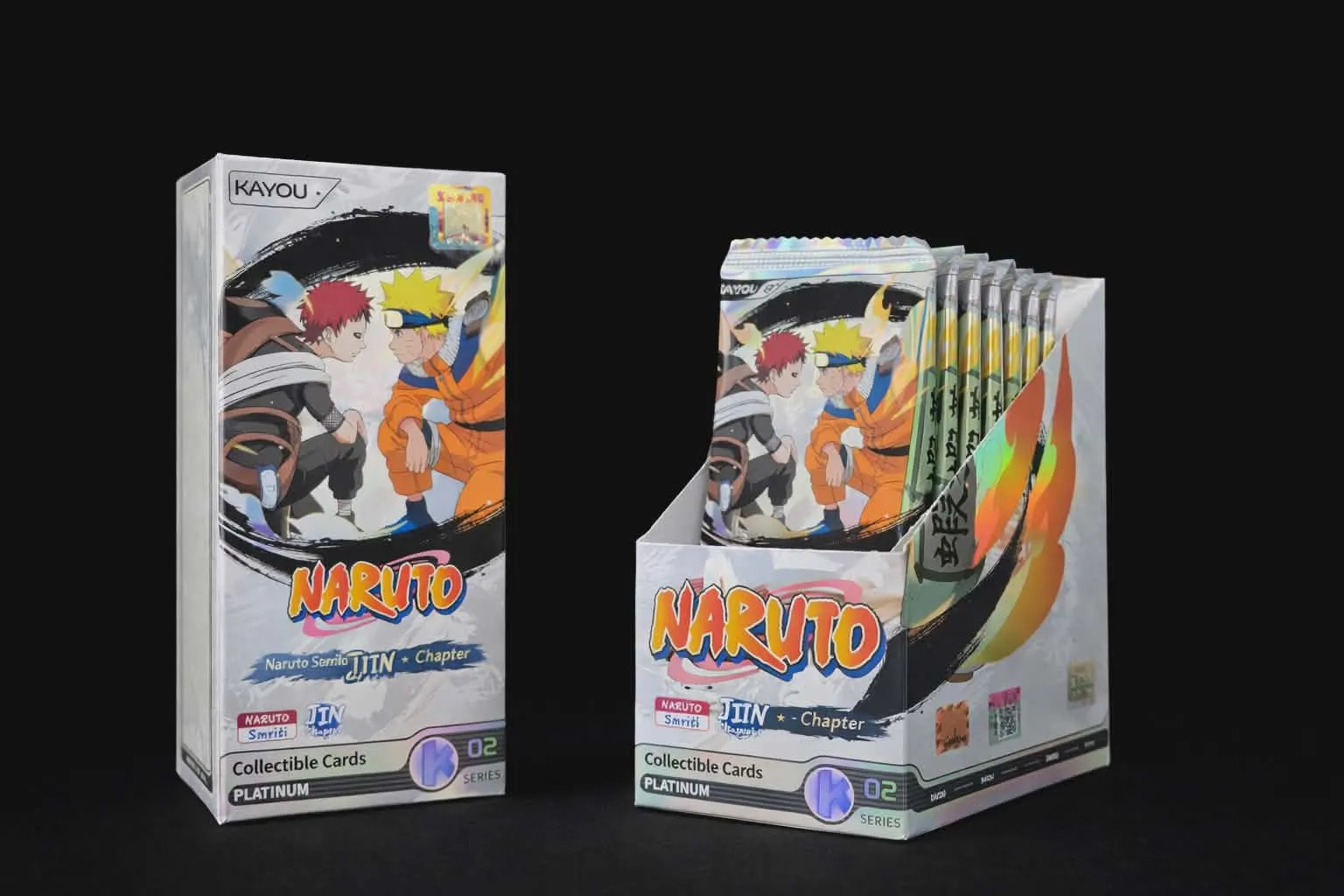
There's a version of this question that's really asking: "Is the hobby worth it?" — and if that's you, the answer lives in Are KAYOU Naruto Cards Worth It?, which covers the collecting and opening experience in full. This post is specifically about the money side: do KAYOU Naruto cards hold value over time, can you profit from them, and should you think of them as an investment? Those are genuinely different questions, and they deserve a straight answer.
Quick Answer: Are KAYOU Naruto Cards a Good Investment?
Probably not in the way that word usually implies. The KAYOU Naruto secondary market is young, thin, and poorly documented — especially in English-speaking markets like Australia. Price discovery is unreliable, liquidity is low, and there is no decades-long price history to lean on. Certain high-end serialised cards do trade for meaningful sums, but for most collectors most of the time, the honest framing is: collect because you love it, and treat any value appreciation as a bonus rather than a goal.
What Actually Drives a KAYOU Naruto Card's Value
Before you can evaluate KAYOU as an investment, you need to understand what makes one card worth more than another. Several factors interact:
Serialisation and rarity tier. Cards with a printed serial number — say, one of only a few hundred in existence — carry inherent scarcity that the market can price. Unnumbered commons have none of that. The rarity ladder matters enormously here, and it varies between editions (SEA and NA editions have different structures, so a rarity tier in one release may not map cleanly to another). For a detailed breakdown of how the rarity system works, see How Rare Is My KAYOU Naruto Card?.
Character demand. KAYOU's Naruto IP means character popularity matters. Cards featuring the most beloved characters in the series — particularly at high rarity — command more attention than supporting cast equivalents at the same tier. This is collector demand, not competitive utility: KAYOU cards have no gameplay, so there are no tournament cycles driving demand spikes the way a game mechanic might.
Condition. A card pulled from the pack and immediately sleeved will always be worth more than one that's been handled loosely. Centering, surface scratches, and corner wear all affect perceived value, particularly if a card ever goes to grading. More on that below.
Edition and wave. Early-print-run or discontinued waves sometimes become harder to source, which can tighten supply. Whether that translates to sustained price increases depends on whether collector demand holds up — and that's genuinely hard to predict for a product line with KAYOU's short English-market history.
For a look at which specific cards sit at the top of the rarity hierarchy, Rarest KAYOU Naruto Cards covers the chase tier in detail.
Which Cards Hold Resale Interest (and Which Are Bulk)
The spectrum is wide, and most of it sits at the low end.
Common and uncommon cards have near-zero resale value individually. They're worth opening for the experience, not for the secondary market. If you're pulling them hoping to flip them, you'll be disappointed.
Mid-tier rares — cards that aren't serialised but sit above the base set — have modest trade value in the right community spaces, but the market is so thin that finding a buyer at any particular price is genuinely difficult. You might wait weeks.
High-rarity chase cards, particularly those with a serial number, are where meaningful secondary market activity exists. These are the cards people actually post about, compare, and sometimes pay serious money for. Even here, though, "serious money" is relative and inconsistent — two sales of the same card a month apart can show significant price variation simply because the market is so small.
Serialised cards occupy their own category. A low-number serial from a popular character in a limited wave is the closest thing KAYOU has to a confirmed collectible with trackable interest. The KAYOU Naruto Serialised Cards Guide goes into how these work in detail, and Rarest KAYOU Naruto Cards puts them in context.
How the KAYOU Naruto Secondary Market Actually Works
This is where honest analysis gets uncomfortable for anyone hoping for a clean investment thesis.
The English-speaking KAYOU secondary market — which includes Australia — is genuinely thin. Most secondary activity happens in niche Facebook groups, Discord servers, and a handful of dedicated collector forums. eBay listings exist, but completed sales data is sparse and inconsistent. There is no equivalent of TCGPlayer for KAYOU; there is no live price feed; there is no population report telling you how many copies of a given card have been graded.
Deeper secondary markets for KAYOU exist on platforms primarily serving Chinese-speaking collectors, where the product originated. Those markets are more liquid and have more comparable sales — but they're largely inaccessible to most Australians in a practical sense, whether due to platform availability, language barriers, or shipping logistics.
What this means in practice: price discovery is poor. When you go to sell a card, you're largely guessing at what it's worth based on limited data. You might sell under market; you might ask over market and wait a long time. The exit you assumed would be there might not materialise on a useful timeline.
Condition, Grading and Resale
If you're collecting with any eye toward future value, condition is non-negotiable. Sleeve pulls immediately. Store in a cool, dry environment. Don't stack unprotected cards.
Grading — sending cards to a third-party grader like PSA or BGS — can add credibility to high-value cards and make them easier to sell to serious collectors who don't want to evaluate raw cards themselves. A graded card carries a condition verdict that the market can price.
The catch is cost. Grading fees, shipping (often international), and turnaround times can collectively eat into any margin a card might otherwise have. For lower-value cards, grading will almost certainly cost more than the value it adds. For genuinely high-end serialised pulls, the calculus might work — but you need to go in clear-eyed. How to Grade KAYOU Naruto Cards covers the process, and Is It Worth Grading KAYOU Naruto Cards? works through the cost-versus-benefit question directly.
KAYOU vs Pokémon: Why the Comparison Misleads
The Pokémon comparison comes up constantly, and it's understandable — first-edition Pokémon cards are one of the most prominent examples of a collectible that appreciated dramatically over time. People want to know if KAYOU is the next Pokémon.
The honest answer is: the parallel is tempting but unreliable.
Pokémon's price appreciation came from a decades-long combination of factors: a massively popular game with active tournament play driving ongoing card utility, nostalgia cycles as 90s kids reached adult income levels, a well-documented print history, and a secondary market infrastructure that developed over 25+ years. The 2020–2021 peak was the product of all of those factors converging with pandemic-era spending patterns.
KAYOU Naruto cards are collectibles, not game pieces — there are no tournaments, no gameplay mechanics, no in-game utility driving demand. The IP (Naruto) is beloved, but the card product has a short English-market history and nothing close to Pokémon's decades of secondary market infrastructure. That doesn't mean KAYOU can't appreciate — it means the Pokémon analogy doesn't give you a reliable basis for assuming it will.
If you hear people searching for "naruto tcg," that's a common search pattern, but worth clarifying: KAYOU Naruto cards are a collectible product, not a trading card game.
The Honest Take: Collect First, Value as a Bonus
Here's what we'd tell a mate who asked.
Buy KAYOU Naruto cards because you love the Naruto franchise, because the opening experience is genuinely enjoyable, and because building a collection you're proud of is a legitimate reason to participate in a hobby. If a card you pull turns out to be worth something down the track, that's a genuine bonus — and with serialised chase cards, it's not an unreasonable hope.
But if you're buying with the expectation of profit — treating boxes as an asset class, calculating expected returns, planning an exit strategy — the current state of the KAYOU secondary market doesn't support that framing. The data isn't there. The liquidity isn't there. The infrastructure isn't there.
That doesn't make KAYOU a bad hobby. It makes it a hobby, not an investment — and there's nothing wrong with that.
If you're ready to start collecting, the Jin Chapter is a popular entry point, or browse the full range of booster boxes to find what suits you.
Frequently Asked Questions
Do KAYOU Naruto cards hold their value over time?
Some do, most don't. Serialised and high-rarity cards from popular character sets hold the most secondary market interest, while common and uncommon cards have minimal resale value. Even for the cards that do hold interest, the market is thin enough that realising that value — finding a buyer at a fair price — can be difficult and time-consuming.
Which KAYOU Naruto cards are worth the most?
Serialised cards — those with a printed numbered edition — sit at the top of the value hierarchy, particularly low-number serials featuring popular characters. High-rarity chase cards from limited or discontinued waves also attract the most secondary market attention. See Rarest KAYOU Naruto Cards for a closer look at what sits at the top of the rarity ladder.
Is it worth keeping serialised KAYOU Naruto cards?
Generally yes, if you're going to keep any cards at all. Serialised cards carry inherent scarcity and tend to attract more collector interest than unnumbered cards at equivalent rarities. Store them immediately in a hard sleeve or card saver, keep them in excellent condition, and be patient — the market is small, so finding the right buyer takes time. The KAYOU Naruto Serialised Cards Guide is worth reading before you decide how to handle them.
Can you sell KAYOU Naruto cards in Australia?
Yes, though the local market is limited. Most Australian sellers use eBay, dedicated Facebook collector groups, and Discord communities. The pool of buyers is smaller than you'd find for Pokémon or Yu-Gi-Oh, so expect longer wait times and less predictable pricing. For high-value cards, patience and targeting the right audience matters more than platform.
Do KAYOU Naruto cards increase in value like Pokémon cards?
The honest answer is that nobody knows — and anyone who tells you otherwise with confidence is speculating. Pokémon's price history is the product of decades of infrastructure, game-driven utility, and nostalgia cycles that KAYOU doesn't share. KAYOU may develop its own appreciation story over time, but drawing a direct parallel to Pokémon's trajectory isn't supported by the current evidence. If you want to understand the hobby case rather than the investment case, Are KAYOU Naruto Cards Worth It? covers that well.
Is grading worth it for resale?
For most cards, no — grading costs (fees, international shipping, turnaround time) typically exceed the value added. For genuinely scarce, high-demand cards like low-number serialised pulls, the calculation can work in your favour, but you need to model the full cost before sending anything off. Is It Worth Grading KAYOU Naruto Cards? walks through exactly when it makes sense and when it doesn't.
Keep Exploring
Continue into the most relevant buying pages and cornerstone guides from this topic.
Cornerstone
KAYOU Naruto Cards Australia: The Full Guide
Start here for an end-to-end view of sets, rarities, and the local buying experience.
Read the full guideChase cards
Rarest KAYOU Naruto Cards
The chase cards collectors are hunting and what makes each one valuable.
See the chase listBuying
Best KAYOU Naruto Booster Box to Buy in 2026
The 2026 box rankings: value, chase potential, and the right one for your budget.
See the 2026 picksHonest take
Are KAYOU Naruto Cards Worth It?
An honest collector's read on value, authenticity, and the long-term hold case.
Read the honest takeWritten By
Cottier TCG Editorial Team
Bringing you the latest and most accurate TCG news from across the globe. Based in the Central Coast, NSW Australia.
Collectors Club
Enjoyed this guide? Get the next drop first.
Join the Collector's Club for restock alerts, new collector guides, and early access to KAYOU Naruto boxes before they sell out.
New members get 10% off your first order
Keep Reading
Other stories you might enjoy from our experts.
Jin Chapter Series 3 (NA) and Series 2 (SEA) are different editions, not a straight upgrade — different box format, promo, and serialised chase cards S2 does not have. The honest comparison.
KAYOU Naruto Card Value: How to Work Out What Your Card Is Worth
No official KAYOU Naruto price list exists, so how do you work out what your card is worth? The five factors that drive value, and how to check real eBay AU sold comps.
KAYOU Naruto Earth Scroll Series 2 Booster Box: The Complete Guide
Inside the KAYOU Naruto Earth Scroll Series 2 booster box: 30 packs, 132 card types across 8 rarities, the box-printed odds, and how it compares to Jin Chapter. In stock in Australia.