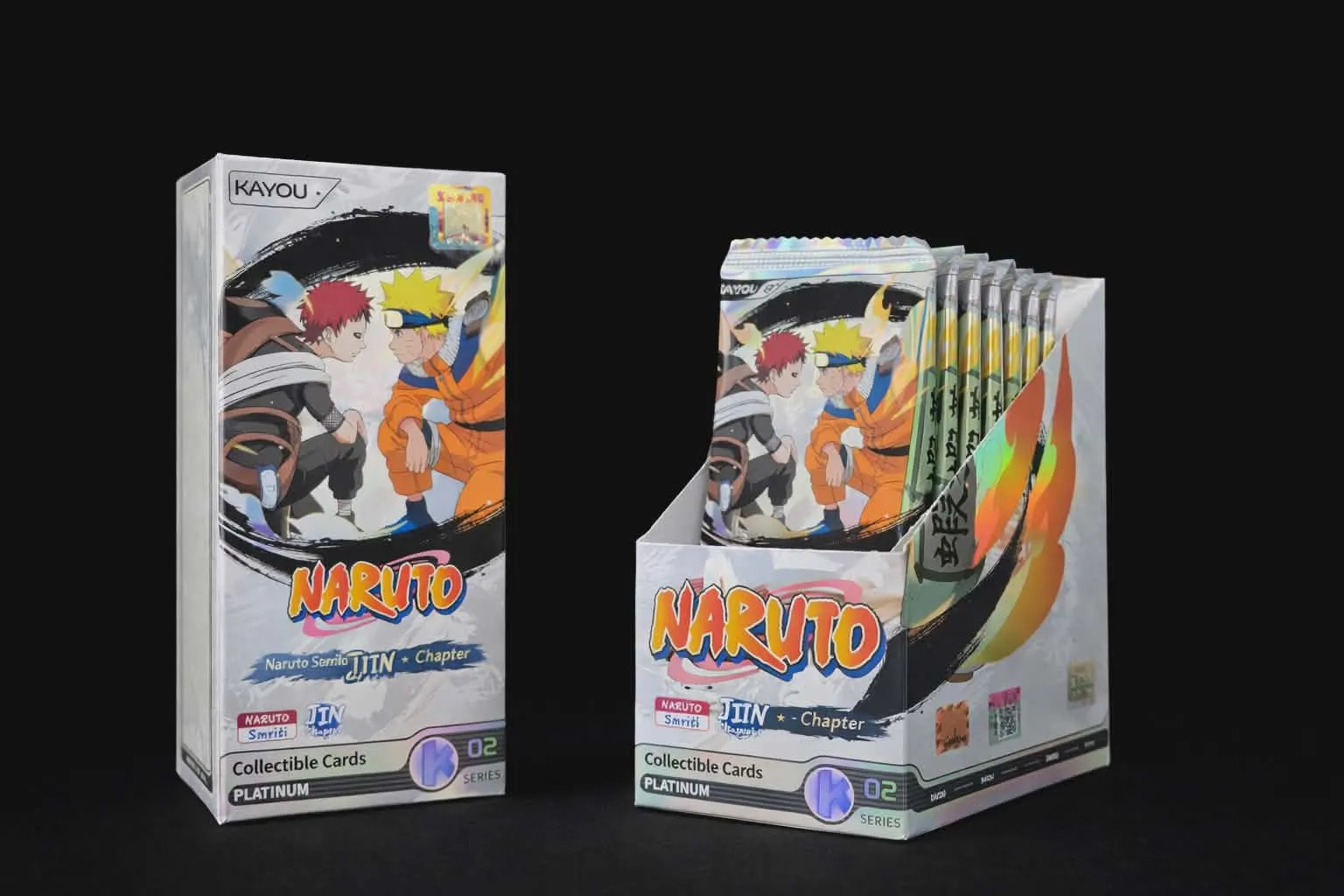
You pulled something shiny from a KAYOU Naruto pack, and now you want to know the only two things that matter in the moment: how rare is it, and is it worth anything? It is the most-asked question in the KAYOU collector community — every day someone posts a card with "how rare is this?" or "is this any good?"
This guide is the answer. It walks through how to read what you pulled — the rarity tier, the serial number — and the honest factors that decide what a card is actually worth. KAYOU Naruto cards are collectibles, not a trading card game: there is no gameplay, so "rarity" here means scarcity and collector demand, not playability.
Quick Answer
A KAYOU Naruto card's rarity is printed on the card as a short tier code — letters like SR, SSR, UR, MR, AR, SP, SE or PTR — and, on the scarcest cards, a serial number stamped like 97/99 or 1/9. The shorter the print run (the smaller the number after the slash), the rarer the card. Value then comes down to five things: the rarity tier, the character (Itachi, Sasuke, Kakashi, Gaara and Minato lead demand), the serial number, the card's condition, and how many collectors currently want it. There is no official price guide — the secondary market sets value, and you check it against recent eBay sold listings.
Step 1 — Read the rarity tier (the letters)
Every KAYOU Naruto card carries a rarity code, usually near a bottom corner or stamped into the foil. Common tiers, roughly low to high: R (regular), SR (super rare), SSR, UR (ultimate rare), with premium tiers such as AR, MR, SP, SE, PU and BP, and the textured PTR (Parallel Texture Rare) sitting among the most chased.
One important catch: the rarity ladder is not identical across lines. Jin Chapter and Earth Scroll use different ladders — Earth Scroll Series 2, for example, runs an eight-tier ladder up to a Diamond UR and CR, and guarantees an SR per pack rather than a PTR. So a tier that is mid-table in one line can sit near the top in another. Our card rarity guide breaks down each ladder, and the rarity tiers glossary is a quick lookup.
Step 2 — Check for a serial number
The rarest KAYOU cards are serialised — individually numbered like 97/99, 12/50, or the grail-tier 1/9. Read it as: the number after the slash is how many copies of that exact card exist; the number before is your specific copy. A card stamped /9 or /10 is among the scarcest things in the line — those are the "#1 of 9 in the world" pulls people lose their minds over. A /99 is still a limited, serialised card, just a larger run.
If your card has no serial number, it is not serialised — its rarity is set entirely by its tier (Step 1). Our serialised cards guide covers how KAYOU numbers its short-run cards and which sets include them.
Step 3 — Weigh the value factors
Rarity tells you how scarce a card is; value is scarcity times demand. Five things move the price:
- Tier — higher tiers and serialised cards command the most.
- Character — fan favourites carry a premium. Itachi, Sasuke, Kakashi, Gaara, Minato and Naruto himself consistently outsell a same-tier card of a minor character.
- Serial number — smaller total runs are rarer, and collectors also pay up for "first copy" numbers like 1/99.
- Condition — sharp corners, a clean surface and good centring matter. A played card is worth a fraction of a mint one; serious cards get graded.
- Demand right now — a character trending from a recent anime moment can spike.
For a sense of what the top end looks like, our rarest KAYOU Naruto cards round-up tracks the chase cards that hold the most value.
Step 4 — Make sure it is genuine
Value only counts if the card is real. Before you celebrate a big pull — or pay for one online — run the basic authenticity checks: the KAYOU security hologram, the set and edition printing, and pack or box details that match the edition spec. Our guide to spotting fake KAYOU cards walks through each check. Edition matters too: most stock sold in Australia is the SEA English edition, and SEA and NA prints differ in card counts and some rarities.
Where to check what yours is worth
There is no official KAYOU price list. The realistic ways to value a card:
- eBay sold listings (filter to Sold items) — the closest thing to a live market price for the exact card and tier.
- Collector communities — the KAYOU Naruto subreddits and Discords price-check pulls daily; that is where "how rare is this?" gets answered by people who actually trade these.
- Pull rarity as a proxy — how hard a tier is to pull from a sealed box tells you how scarce it is to begin with. Our pull rates and box odds explainer covers the realistic odds per line.
If you see a tier or code you do not recognise on an import listing, the tier and wave system explainer decodes KAYOU's naming.
Want a better shot at the chase cards?
If reading this made you want to chase a serialised pull of your own, the line you open changes your odds. Jin Chapter is KAYOU's premium chase line and guarantees a PTR in every SEA-edition pack; Earth Scroll gives you far more packs per box for more chances at a hit. Not ready for a full box? Single packs are the low-commitment way in.
Frequently Asked Questions
How do I know if my KAYOU Naruto card is rare?
Check the rarity code printed on the card — letters such as SR, SSR, UR, MR, AR, SP, SE or PTR — and look for a serial number like 97/99. Higher tiers and serialised, short-run cards are the rarest. Because the rarity ladder differs between Jin Chapter and Earth Scroll, cross-check the tier against our rarity guide.
What does the number like 97/99 on my Naruto card mean?
It is a serial number on a limited card. The number after the slash is how many copies of that card exist (smaller is rarer); the number before is your individual copy. A card numbered /9 or /10 is among the scarcest in the line. See our serialised cards guide.
Are KAYOU Naruto cards worth anything?
Some are worth a lot and most are worth a little — it depends on tier, character, serial number, condition and demand. The rarest serialised chase cards command high secondary-market prices, while common cards are inexpensive. There is no official price guide, so check recent eBay sold listings for the exact card.
What is the rarest KAYOU Naruto card?
The rarest cards are low-run serialised pulls of popular characters. Our rarest KAYOU Naruto cards guide tracks the current chase cards and what makes them valuable.
Is my KAYOU card a "Naruto TCG" card?
No — KAYOU Naruto cards are collectibles with no gameplay, even though people often search "Naruto TCG". The only playable Naruto card game is Naruto Mythos, a separate product: see our Naruto Mythos vs KAYOU comparison.
Where can I sell or value a KAYOU Naruto card in Australia?
Use eBay sold listings for a market price, and the KAYOU collector communities to price-check. For high-value cards, grading can help establish condition and value before selling.
Keep Exploring
Continue into the most relevant buying pages and cornerstone guides from this topic.
Cornerstone
KAYOU Naruto Cards Australia: The Full Guide
Start here for an end-to-end view of sets, rarities, and the local buying experience.
Read the full guideChase cards
Rarest KAYOU Naruto Cards
The chase cards collectors are hunting and what makes each one valuable.
See the chase listBuying
Best KAYOU Naruto Booster Box to Buy in 2026
The 2026 box rankings: value, chase potential, and the right one for your budget.
See the 2026 picksHonest take
Are KAYOU Naruto Cards Worth It?
An honest collector's read on value, authenticity, and the long-term hold case.
Read the honest takeWritten By
Cottier TCG Editorial Team
Bringing you the latest and most accurate TCG news from across the globe. Based in the Central Coast, NSW Australia.
Collectors Club
Enjoyed this guide? Get the next drop first.
Join the Collector's Club for restock alerts, new collector guides, and early access to KAYOU Naruto boxes before they sell out.
New members get 10% off your first order
Keep Reading
Other stories you might enjoy from our experts.
Naruto Gift Ideas Australia: The Card Buyer's Guide
No collector knowledge required: how to pick the right KAYOU Naruto cards as a gift — pack, box or bundle — matched to the recipient, with honest guidance for parents on ages and blind-pack expectations.
How to Spot Fake KAYOU Naruto Cards
Fake KAYOU Naruto cards exist — but most fake scares are really edition confusion. The print, foil, packaging, and price checks collectors actually use, plus where the risk concentrates and how Australian buyers stay protected.
Heaven Scroll Series 1 is KAYOU's new Smriti-brand premium Naruto line — NA edition only for now. What's in the box, how it compares to Jin Chapter and Earth Scroll, and where Australian collectors stand.