Shop this guide
Live price & stock · dispatched from NSW.
There's a lot of noise in the KAYOU Naruto community about Chinese cards versus English cards — which is "real," which is rarer, and what you're actually getting when you buy in Australia. Most of the hot takes are wrong. Here's the straight version.
Quick Answer
KAYOU is a Chinese manufacturer. The Chinese edition is the original, largest print run — it's official and legitimate. English editions (SEA and NA) are licensed regional releases with different packaging formats and, in some cases, different rarity ladders. Australian retailers stock the English SEA edition. Neither language version is inherently more valuable than the other — rarity, character, and condition drive value.
The Three Print Families: Chinese, SEA English, NA English
KAYOU Naruto cards exist in three distinct print families, and conflating them causes most of the confusion you see online.
Chinese (CN) edition — This is where the line started. The CN edition is produced by KAYOU for the Chinese domestic market. It has the longest print history, the widest range of sets, and the largest collector base by volume. Card text is in Simplified Chinese.
SEA English edition — A licensed English-language release distributed across South-East Asian markets, including Australia. Same KAYOU IP, different packaging format. Card text is in English.
NA English edition — A separate licensed English release for North America. It has its own pack structure and rarity ladder that differ from the SEA edition.
These are three separate product lines from the same licensor, not three versions of the same product. The SEA vs NA English cards explained post covers the format differences between those two English editions in detail — this article focuses on how Chinese and English cards compare.
Why the Chinese Version Exists (It's the Original)
KAYOU is a Chinese manufacturer, and it developed the Naruto collectible card line for the Chinese market first. The CN edition has been running longer, has more sets in circulation, and has the deepest back-catalogue of any KAYOU Naruto print family.
This matters because some collectors encounter Chinese cards and assume they must be imitations of the English release — it's the opposite. The English editions are the regional adaptations; the CN edition is the source material. Both are produced by or under licence from KAYOU.
How the English Editions Differ from Chinese
The differences are real but often misunderstood. A few things change between CN and English editions:
Language, obviously. Card text, set names, and packaging copy shift from Simplified Chinese to English. For collectors who can't read Chinese, the English editions are easier to interact with at a glance — though rarity symbols and card numbering use consistent visual systems across editions.
Pack and box format. Pack sizes and cards-per-pack can differ between editions. The SEA English edition has its own pack configuration that doesn't map directly onto CN packs. Don't assume a CN box and an English SEA box contain equivalent pull structures — they may not.
Set availability. Not every CN set receives an English localisation. The CN catalogue is larger, so some sets, promos, and serialised releases exist only in Chinese. Conversely, the English release schedule sometimes lags behind CN by months.
Rarity systems. The broad rarity tiers (common, rare, super rare, and so on) exist across editions, but specific chase card types and serialisation formats vary. Check the card rarity guide for how the tiers work in the English editions available in Australia.
Are Chinese Cards Rarer or More Valuable? (The Honest Answer)
No blanket answer holds here. Value in collectibles is driven by specific supply, specific demand, and condition — not by language alone.
A few dynamics worth understanding:
- Certain CN-exclusive serialised cards or early print runs carry demand from collectors who specifically want those versions. If a card only exists in CN, there's no English equivalent competing for the same buyers.
- Some English-edition cards appeal to buyers who prefer readable text or who are building sets from the English catalogue specifically. That preference creates its own demand.
- Print volumes vary by set and region. A low-print CN set and a low-print SEA set are both scarce — language doesn't automatically resolve the comparison.
- Condition standards are universal. A damaged card loses value regardless of edition.
If you're researching value on a specific card, the relevant question is: what edition is this card from, how many were printed, and what are buyers in my market willing to pay right now? Language is one data point, not the deciding one.
For a broader look at what makes the hobby worthwhile, are KAYOU Naruto cards worth it is a good read.
"Is the Chinese Version Fake?" — No, and Here's the Real Fake Problem
This is the most persistent myth in the KAYOU community, and it needs a direct answer: Chinese KAYOU Naruto cards are not fake. They are the original, official product produced by the manufacturer.
The confusion comes from two places. First, people unfamiliar with the brand assume that because KAYOU is a Chinese company making cards from a Japanese franchise, something must be unofficial. KAYOU produces the Naruto line under official licence — both CN and English editions are authorised products.
Second, counterfeits exist. But counterfeits can be of either edition — fake CN cards, fake English cards. The fake problem is about individual card authenticity, not about which language version is real. A Chinese-language KAYOU Naruto card is no more likely to be a fake than an English one.
If you want to learn how to identify counterfeit cards regardless of edition, how to spot fake KAYOU Naruto cards walks through the practical checks.
What Australian Buyers Actually Receive
Australian retailers, including CottierTCG, stock the English SEA edition. When you purchase a booster box or booster pack through an Australian store, you're getting English-language cards from the SEA regional release — not CN edition cards.
This is worth knowing before you buy. If you're specifically after CN edition cards for collection or comparison purposes, you'll need to source those separately through specialist importers or secondary market sellers. If you want English SEA cards — which is what most Australian collectors are building sets with — local retailers are your most straightforward option.
For more on what the English edition looks like in an Australian context, English KAYOU Naruto cards in Australia covers the local availability picture.
Which Version Should You Collect?
Depends on what you're optimising for.
Collect English SEA if: You want readable card text, you're building a set alongside other Australian collectors, and you want to buy easily through local retailers without international shipping or customs.
Explore CN edition if: You want access to the full KAYOU catalogue (including sets not localised to English), you're chasing specific serialised CN-exclusive cards, or you're comfortable reading Chinese or just collecting for visual appeal.
Both at once is also a legitimate approach — some collectors pick up English copies for display or set completion and hunt CN versions of specific characters they care about.
Neither choice is wrong. The community contains both, and they're not in competition.
Frequently Asked Questions
Is the Chinese version of KAYOU Naruto worth more than English?
Not as a rule. Value depends on the specific card, its rarity within its edition, print volume, and current buyer demand. Some CN-exclusive serialised cards command strong interest; some English-edition chase cards do too. Research the specific card, not the language category.
Are English KAYOU Naruto cards rarer?
Not inherently. English editions have smaller geographic distribution than the CN edition, but "rarer" requires comparing specific set print runs. Some English sets have been produced in large volumes; some CN sets have been produced in limited runs. Language alone doesn't determine scarcity.
Are Chinese KAYOU Naruto cards fake or unofficial?
No. KAYOU is a Chinese company and the CN edition is their original, domestic product, produced under official licence. Both CN and English editions are official. Counterfeits of KAYOU cards exist, but they can imitate any edition — this is a card-level authenticity issue, not a language-level one.
Can you tell a Chinese card from an English card at a glance?
Yes, fairly easily. Card text, set name, and packaging will be in Simplified Chinese on CN cards and in English on SEA or NA cards. Card-back designs and rarity symbols follow consistent visual conventions across editions, but the text language is the clearest immediate tell.
Which version do Australian retailers sell?
Australian retailers, including CottierTCG, sell the English SEA edition. This is the regionally distributed English-language release, not CN edition stock. If you're specifically looking for CN cards, you'll need to source those through importers or the secondary market.
If you're ready to start pulling English SEA edition cards, browse our booster boxes for the full box experience or pick up individual booster packs to dip in without committing to a full box.
Keep Exploring
Continue into the most relevant buying pages and cornerstone guides from this topic.
Buying
Where to Buy Naruto Cards in Australia (2026)
The 2026 buyer's map of trustworthy local stock, dispatch times, and what to avoid.
Find local stockEditions
KAYOU Naruto SEA vs NA Editions
Which English edition you get in Australia (SEA for most lines, NA for Series 3) and what it changes.
Compare the editionsEnglish stock
KAYOU Naruto English Cards in Australia
What's actually printed in English and how the licensed runs reach Australian collectors.
See the English rangeBrand hub
KAYOU Naruto Cards Australia
The whole line at a glance — Jin Chapter and Earth Scroll, every series and edition, with sealed boxes, packs and bundles in stock.
Explore KAYOU NarutoWritten By
Cottier TCG Editorial Team
Bringing you accurate KAYOU collecting news and buying guides for Australian collectors. Based in the Central Coast, NSW Australia.
Collectors Club
Enjoyed this guide? Get the next drop first.
Join the Collector's Club for restock alerts, new collector guides, and early access to KAYOU boxes before they sell out.
New members get 10% off your first order
Keep Reading
Other stories you might enjoy from our experts.
KAYOU Naruto Earth Scroll Series 3 Card List: All 122 Cards, Rarities and Pull Odds
Every KAYOU Naruto Earth Scroll Series 3 card pictured by tier, with KAYOU's printed pack ratio worked out for a 20-pack box, the CR code oddity, how the set compares with Earth Scrolls 1 and 2, and the Australian pre-order.
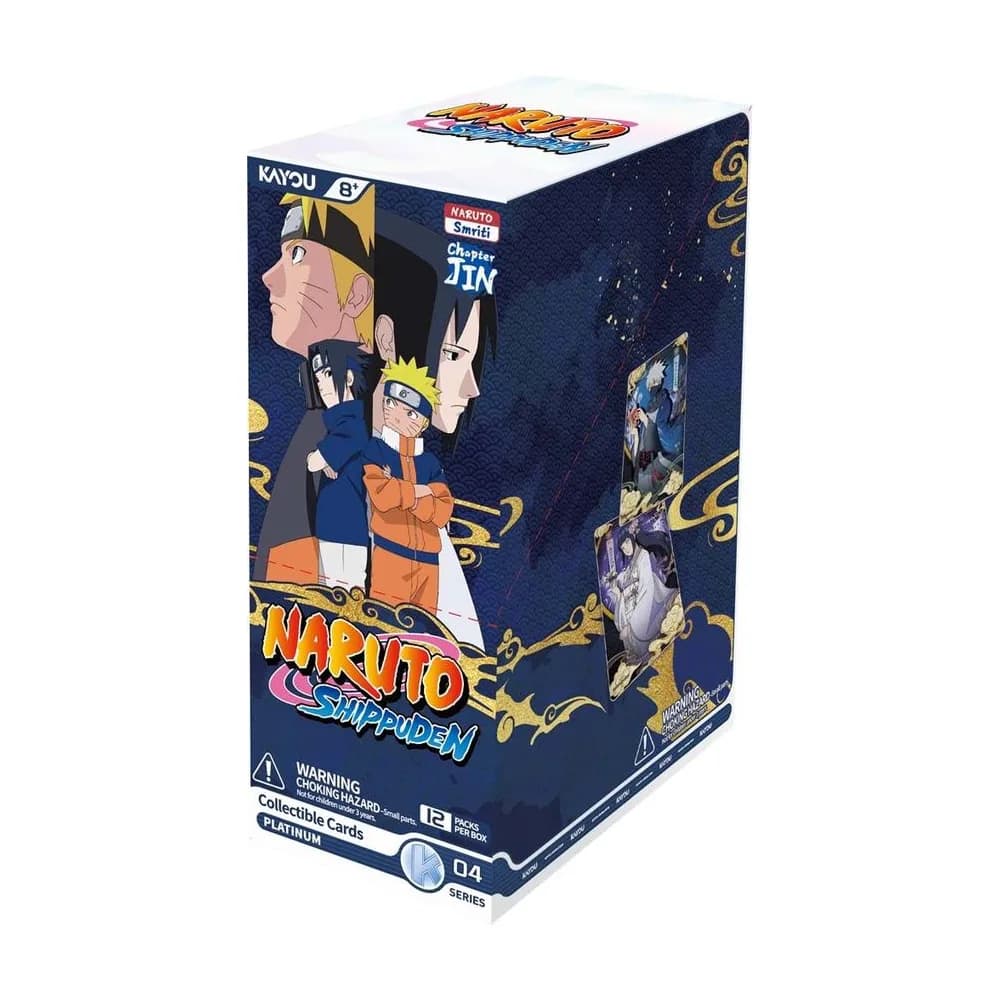
KAYOU Naruto Jin Chapter Series 4: Release Date, Numbered Cards and Where to Pre-order in Australia
KAYOU's first English Naruto: Shippuden set explained: US and Australian release dates, the 12-pack box and 16-box case, KAYOU's 186-card, 13-rarity chart, the five numbered rarities and their print runs against Series 3, and how to pre-order from NSW.
Most Valuable KAYOU Naruto Earth Scroll Series 2 Cards: Itachi CR and the Real Chase
Itachi CR sold 23 times at a A$384 median, from a cheap box. The Diamond UR the box advertises is a A$50 card. Every Earth Scroll Series 2 card worth money, from completed eBay AU sales.