Shop this guide
KAYOU Naruto Cards Australia
The whole line at a glance — Jin Chapter and Earth Scroll, every series and edition, with sealed boxes, packs and bundles in stock.
Explore KAYOU NarutoNo. KAYOU Naruto is a licensed collectible card line. It is not a playable trading card game, and there are no rules, decks, or matches to be found in any Jin Chapter, Earth Scroll, or Heaven Scroll box. If you searched "Naruto TCG" and landed on KAYOU product, you have found the collectible side of the hobby, and this guide explains where the actual games sit.
Quick Answer: KAYOU Naruto cards are collectibles. Each card carries artwork, a rarity tier, and sometimes a serial number, but no rules text, no stats, and no deck-building system. The playable Naruto games are the discontinued Bandai Naruto Collectible Card Game (English, 2006 to 2013) and the new Naruto Mythos from Italian publisher Cicaboom (launched March 2026). They are separate products from separate companies. KAYOU cards cannot be used in either one.
Is it a TCG? What KAYOU Naruto actually is
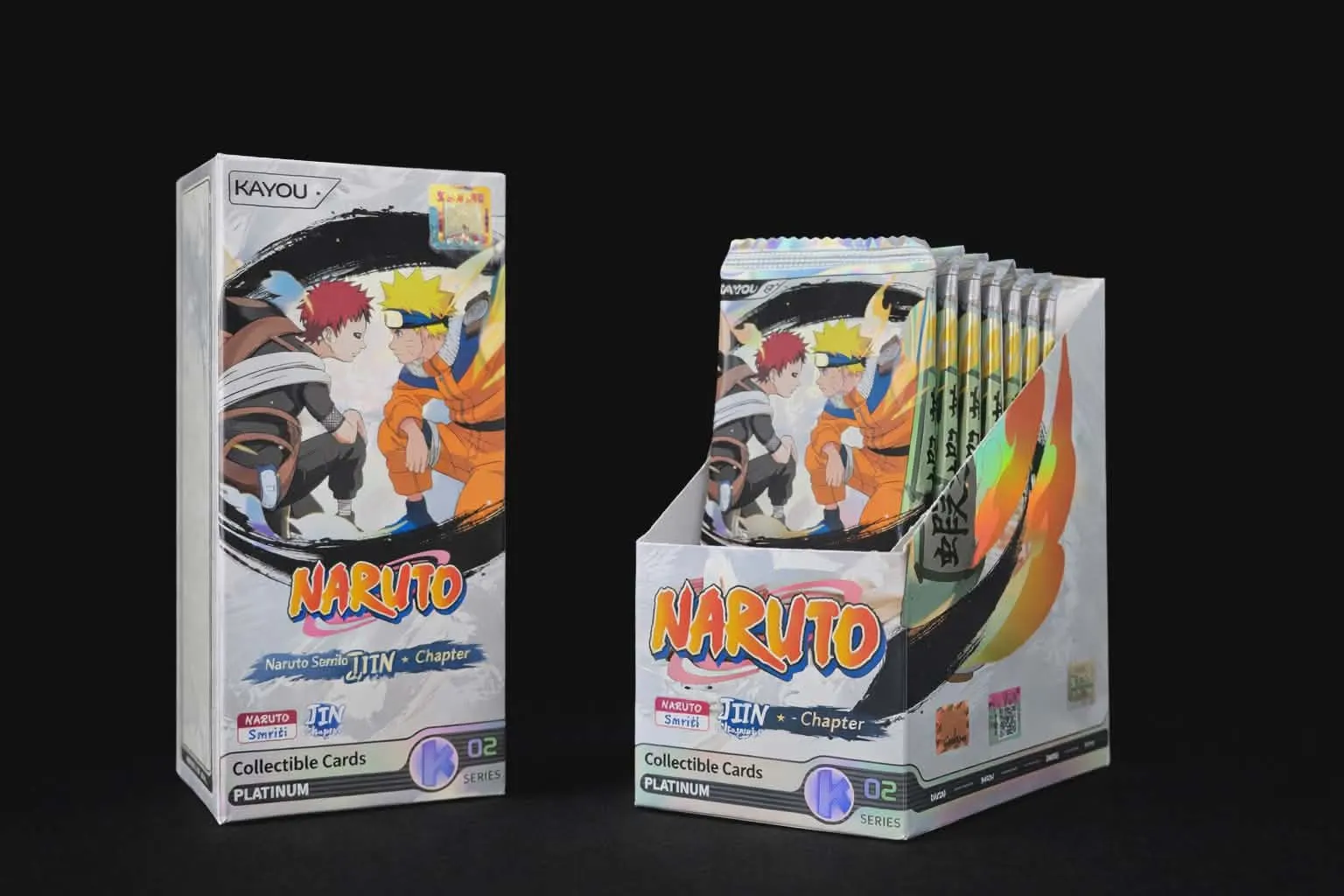
KAYOU Naruto is an officially licensed collectible card line made by KAYOU, a Chinese manufacturer that holds the licence to print Naruto artwork on cards. The product is sold in booster packs and booster boxes, with cards sorted into rarity tiers such as R, SR, SSR, UR, and serialised chase cards. The hobby is about pulling, sorting, and displaying cards, not playing with them.
That last part is the whole distinction. A trading card game, in the sense people usually mean, has three things: printed rules on the cards (attack values, costs, effects), a deck-building structure, and an opponent to play against. KAYOU Naruto has none of the three. Turn any card over and you will find artwork, a set code, and a rarity marker. There is nothing telling you what the card does, because it does not do anything.
If the terms above are new to you, our Naruto cards glossary defines every rarity abbreviation and edition label used across the range.
Why the confusion exists
Three things push people to search "Naruto TCG" and end up on KAYOU cards.
- The packaging looks like a game. Booster packs, booster boxes, foil cards, rarity symbols, and a chase-card ladder are all borrowed from the language of Pokémon and Yu-Gi-Oh!. The format is identical even though the purpose is not.
- Marketplace listings use the wrong words. Overseas sellers on eBay, AliExpress, and TikTok Shop often put "Naruto TCG" in the listing title for KAYOU product. They do it because it pulls more search traffic. It is a labelling habit, not a description of the product.
- Two real Naruto games exist. One ran for years and then stopped, and one is brand new. Both of them have "card game" in their name and both use Naruto artwork, so it is easy to assume every Naruto card belongs to one of them.
Our KAYOU Naruto cards Australia guide walks through the full range if you want to understand the sets before the comparison below.
Bandai Naruto Card Game vs Naruto Mythos vs KAYOU Naruto
Here is the side-by-side view of the three products people mix up. Where a detail is not confirmed by the publisher, we say so.
| Feature | Bandai Naruto CCG | Naruto Mythos | KAYOU Naruto |
|---|---|---|---|
| Publisher | Bandai | Cicaboom (Italy) | KAYOU (China) |
| Years | English release 2006, ended 2013 after set 28 | Set 1 launched 13 March 2026 | Ongoing, multiple series per year since the early 2020s |
| Playable? | Yes | Yes | No |
| Rules and deck building | Yes. 50-card decks, Ninja, Jutsu, Mission, and Client cards, turn-based duels | Yes. Players complete Missions across four rounds; the highest Mission points win | None. No rules text, no decks, no matches |
| Languages and editions | English (also Japanese releases) | Launched in Europe, the UK, Turkey, and MENA; US retail from August 2026; Australia scheduled for later sets | Chinese domestic, SEA (South-East Asia), and NA (English) editions |
| Still in print? | No. Discontinued, second-hand only | Yes, with further sets on the published roadmap | Yes |
| Who it's for | Players of a retired competitive game, and nostalgia collectors | People who want to sit down and play a current Naruto game | Collectors who want licensed artwork, rarity chasing, and display pieces |
Bottom line: if you want to play, you want Naruto Mythos (current) or the old Bandai game (second-hand). If you want to collect, sort, sleeve, and display, you want KAYOU. Nobody should buy KAYOU product expecting a game, and nobody should buy a Mythos starter deck expecting foil-heavy KAYOU-style chase cards.
The Bandai Naruto Collectible Card Game
Bandai launched the Naruto Collectible Card Game in English in 2006, based on the manga, and ran it for about seven years before it ended in 2013 after set 28. It was a proper duel format: two players, 50-card decks, a limit of three copies per card name, with Ninja cards attacking and Jutsu, Mission, and Client cards supporting them. It had organised play and a full rarity structure of its own.
Why Bandai stopped is not officially documented. Community sources suggest licensing changes, but that is speculation rather than a confirmed reason. What matters for you today is that the product is out of print. Sealed packs and singles trade second-hand, mostly through eBay and specialist sellers, and the cards are not compatible with anything currently being made.
Bandai has also announced a brand new "NARUTO CARD GAME" through its Bandai Card Games division, with a worldwide launch planned for 2027. That is a separate product again, so if you see Bandai and Naruto together in a 2026 headline, it is likely referring to this upcoming game, not the old CCG.
Naruto Mythos
Naruto Mythos is the current playable Naruto game. It is published by Cicaboom, an Italian trading card game company, and it launched its first set, Konoha Shido, on 13 March 2026 across Europe, the UK, Turkey, and the MENA region. US retail followed in August 2026. The game is based on the anime rather than the manga, which is the official line used to distinguish it from Bandai's products.
Australia was not a launch territory. Cicaboom's public roadmap lists Australia against later sets, and we track that status closely in our Naruto Mythos TCG Australia buying guide. Read that post for the set list, the local availability picture, and how the game plays. The short version for this article is simply that Mythos is a real game with real rules, and it is a different product from a different company.
Can you play KAYOU Naruto cards?
No. There is no official way to play KAYOU Naruto cards and there never has been. The cards do not carry attack values, costs, effects, or any mechanical text that a game would need, and KAYOU does not publish a rulebook, a deck format, or an organised play program for the Naruto line.
You will occasionally see fan-made rules floating around forums and YouTube. Those are home-brew systems that assign made-up values to cards based on rarity or character. They are fun for a lounge room, but they are not a game in the sense of a TCG: there is no shared ruleset, no balance, no tournaments, and no support from the manufacturer. Two collectors with the same cards could easily be playing two different games.
It also helps to know what you cannot do. KAYOU Naruto cards cannot be used in Naruto Mythos, cannot be used in the old Bandai game, and cannot be mixed into Pokémon, Yu-Gi-Oh!, One Piece, or any other product. The sizes may look similar in a sleeve, but the cards have no function outside their own line.
What you actually do with them
Collecting KAYOU Naruto has its own rhythm, and it is closer to sports cards or Panini stickers than to a game.
- Open packs and pull. The draw of the hobby is the rarity ladder. Every pack has a chance of an SR or better, and box-level inserts can go up to serialised cards. Only Earth Scroll Series 2 has manufacturer-printed odds, so treat any other pull-rate figure as observation, not fact.
- Sort by rarity and set. Collectors organise by series, then rarity, then character. The KAYOU Naruto card rarity guide explains the full tier ladder from R through to CR and serialised.
- Sleeve, bind, and display. Premium cards go into toploaders or binders. Serialised and textured cards are the display pieces of a collection.
- Trade and sell. Rare pulls trade between collectors, and sold listings set the going value. Nothing about that requires a game.
Why collectors still buy them
If you cannot play the cards, it is fair to ask why the line keeps growing. The answer is that KAYOU Naruto does the collecting part of the hobby unusually well.
The artwork is the product. Because there is no rules box crowding the card, the full face is artwork. Higher tiers add foil, texture, layered printing, and character art you will not find on other Naruto merchandise. Collectors who love the series buy these for the same reason they buy figures or prints.
The rarity ladder is deep. Multiple tiers above SSR, plus serialised cards numbered out of a small print run, give the hobby a long chase. A box is a lottery ticket with a floor of minimum-tier pulls and a ceiling that keeps people opening. Whether that trade-off suits you is covered honestly in are KAYOU Naruto cards worth it.
The entry point is low. A single booster pack is an affordable way to try the line, and a booster box gives a full spread of the rarity pool. You can see the current range on our Naruto booster boxes collection page.
It is licensed and consistent. KAYOU is an officially licensed manufacturer, and sealed product carries a security hologram. That matters because counterfeits and edition mix-ups are the main risk in this hobby. If you are unsure what you have, how to spot fake KAYOU Naruto cards goes through the checks, and most "fake" scares turn out to be SEA versus NA edition confusion.
The one playable exception in our store
We do sell one actual game. The My Little Pony TCG is a proper playable product with starter decks, rules, and a deck structure, and you can read about it on our My Little Pony TCG page. That game is a separate product from the KAYOU My Little Pony collectible line, which follows the same pull-and-collect model as KAYOU Naruto. The two share a franchise and nothing else, so check which one you are buying.
Everything on our Naruto hub is KAYOU collectible product. If a listing anywhere calls it a game, the listing is wrong, not the product.
How to tell which Naruto card you are holding
If a Naruto card has landed in your hands and you are not sure which product it came from, three checks settle it in under a minute.
- Look for rules text. A Bandai CCG card has a text box with game effects, a cost, and combat values. A Naruto Mythos card has mission and ability text in the Cicaboom layout. A KAYOU card has artwork, a set code, and a rarity mark, and no instructions of any kind.
- Check the copyright line. The small print at the bottom names the manufacturer. KAYOU cards carry the KAYOU mark and the licensing credit for Naruto. Bandai and Cicaboom cards name themselves.
- Check the language and set code. KAYOU cards use codes such as NR-KP-DZJ for Earth Scroll, and the SEA and NA editions are printed in English with region-specific packaging. The glossary entry on SEA edition vs NA edition explains the differences.
Frequently Asked Questions
Can you play KAYOU Naruto cards?
No. KAYOU Naruto cards have no rules text, no stats, and no official ruleset or deck format. They are collectibles for pulling, sorting, and displaying. Any "rules" you find online are fan-made and not supported by the manufacturer.
Naruto TCG vs KAYOU: what is the difference?
"Naruto TCG" usually refers to one of two playable games: the discontinued Bandai Naruto Collectible Card Game (English 2006 to 2013) or the current Naruto Mythos by Cicaboom (launched March 2026). KAYOU Naruto is a different product from a different company. It is a licensed collectible card line with rarity tiers and no gameplay.
Is there an official Naruto card game you can play right now?
Yes. Naruto Mythos, published by Cicaboom, is the current playable Naruto game and launched in Europe in March 2026 with US retail following in August 2026. Australia is listed for later sets on the publisher's roadmap. Bandai has also announced a new NARUTO CARD GAME for a planned 2027 launch. Neither game uses KAYOU cards.
Why do "Naruto TCG" listings show KAYOU Naruto cards?
Mostly for search traffic. "Naruto TCG" is a popular query, so marketplace sellers tag KAYOU booster boxes with it. The packaging format (packs, boxes, foils, rarity symbols) reinforces the impression. The product itself is a collectible line, not a game.
Does KAYOU Naruto have rules or a rulebook?
No. KAYOU has never published rules, a deck format, or an organised play program for its Naruto line. The cards are designed around artwork and rarity, not mechanics.
Are KAYOU Naruto cards compatible with Naruto Mythos or the Bandai game?
No. The three products come from three different companies with no shared format. KAYOU cards cannot be used in Naruto Mythos, and they cannot be used in the old Bandai game. Do not buy KAYOU product expecting to build a deck.
What is the difference between the Bandai Naruto CCG and Naruto Mythos?
The Bandai game was an English-language duel format that ran from 2006 to 2013 and is now out of print, so it is second-hand only. Naruto Mythos is a new game from Cicaboom that launched in 2026, is based on the anime rather than the manga, and has ongoing set releases. They are unrelated products and their cards are not cross-compatible.
If KAYOU Naruto is not a game, is it still worth collecting?
That depends on what you want. If you want a game, no, buy Naruto Mythos instead. If you want licensed Naruto artwork, foil and textured cards, a deep rarity chase, and a low entry cost, KAYOU Naruto is one of the strongest collectible lines available in Australia. Our worth it guide covers the trade-offs in detail.
Still deciding on the collectible side? Start with the KAYOU Naruto booster box range to see the series and editions currently listed, or head to the Naruto hub for packs, boxes, and every guide we have written on the line.
Keep Exploring
Continue into the most relevant buying pages and cornerstone guides from this topic.
Honest take
Are KAYOU Naruto Cards Worth It?
An honest collector's read on value, authenticity, and the long-term hold case.
Read the honest takeCornerstone
KAYOU Naruto Cards Australia: The Full Guide
Start here for an end-to-end view of sets, rarities, and the local buying experience.
Read the full guideChase cards
Rarest KAYOU Naruto Cards
The chase cards collectors are hunting and what makes each one valuable.
See the chase listBrand hub
KAYOU Naruto Cards Australia
The whole line at a glance — Jin Chapter and Earth Scroll, every series and edition, with sealed boxes, packs and bundles in stock.
Explore KAYOU NarutoWritten By
Cottier TCG Editorial Team
Bringing you accurate KAYOU collecting news and buying guides for Australian collectors. Based in the Central Coast, NSW Australia.
Collectors Club
Enjoyed this guide? Get the next drop first.
Join the Collector's Club for restock alerts, new collector guides, and early access to KAYOU boxes before they sell out.
New members get 10% off your first order
Keep Reading
Other stories you might enjoy from our experts.
Most Valuable KAYOU Naruto Earth Scroll Series 2 Cards: Itachi CR and the Real Chase
Itachi CR sold 23 times at a A$384 median, from a cheap box. The Diamond UR the box advertises is a A$50 card. Every Earth Scroll Series 2 card worth money, from completed eBay AU sales.
Gaara CR A$104, Neji CR A$84, and a ten-card AR tier that reliably sells for A$70 a card. The Earth Scroll Series 1 cards worth keeping, priced from completed eBay AU sales.
Most Valuable KAYOU Naruto Jin Chapter Series 3 Cards: ASP, SE and the Serialised Ladder
ASP /99 cards from A$1,535 raw to A$16,750 graded, SE /220 up to A$3,978, and the AR /777 and BP /999 serials most boxes actually produce. Every Series 3 card worth money, from completed eBay AU sales.